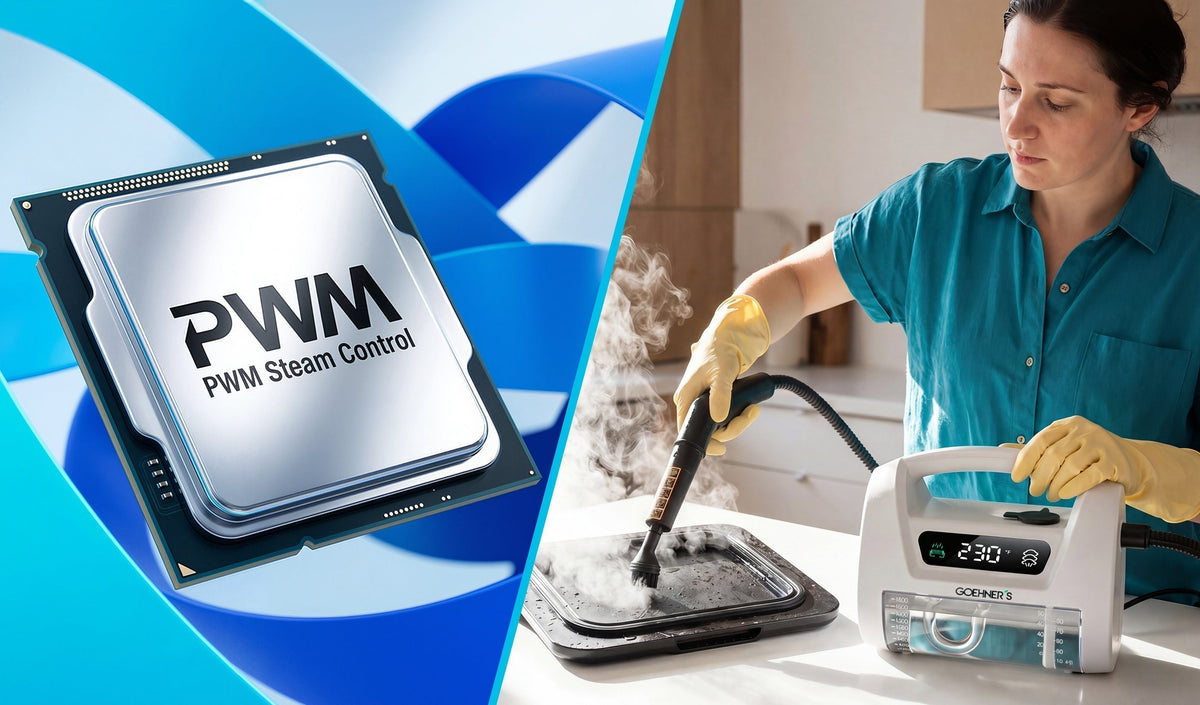
What Is PWM Steam Control - and Why It Matters
The short version: Cheap steam cleaners surge and sputter because they can't precisely control heat or water. PWM (pulse-width modulation) rapidly pulses the heater under a PID loop to hold temperature steady; dual-PWM adds the same control to the water pump for drier steam. The Goehner's Handheld Steam Cleaner uses dual-PWM, so steady steam lasts the whole job.
If you've used more than one handheld steam cleaner, you've felt the problem this article is about — even if you didn't have a name for it.
You squeeze the trigger. Steam comes out strong for a few seconds. Then it weakens. Then it surges back. Then it sputters and spits hot water droplets onto whatever you're cleaning. Then it weakens again. The cleaning result is uneven: some patches sparkle, others have water spots.
This is what happens when a steam cleaner doesn't have intelligent steam control. And it's what "PWM (pulse-width modulation) control" is engineered to reduce.
Why does a handheld steam cleaner's steam surge and sputter?
Steam surges and sputters because simple steam cleaners can't precisely control how much water reaches the heating element — they rely on either on/off heating or a mechanical pressure valve, and both let temperature and pressure swing.
Inside a handheld steam cleaner is a chamber and a heating element that brings the steam up to operating temperature — around 230°F (110°C) at the nozzle on high-pressure units. Because plain steam at normal atmospheric pressure tops out near 212°F (100°C), reaching 230°F at the nozzle depends on the unit holding roughly 50 PSI of pressure; as long as that temperature and the right amount of water reach the heating element, you get steady steam.
The issue is that "the right amount of water" is hard for a simple system to control. Cheap steam cleaners use one of two approaches:
1. On/off heating only. The heating element is either fully on or fully off. The temperature swings up and down a few degrees with each cycle. Steam pressure swings with it.
2. Mechanical pressure regulation. A spring-loaded valve releases steam when pressure exceeds a threshold. This works, sort of — but the valve has to overshoot before it releases, then close before it stops releasing. The result is a slight pulse in output, every cycle.
For light cleaning, neither approach is a disaster. For tough cleaning, both can fail at the wrong moment: just as you're working into a stuck-on stain, the steam softens, and you have to hover and wait for it to recover.
What does PWM do differently?
PWM stands for "pulse-width modulation". It's a control technique borrowed from precision electronics — the same approach commonly used to dim LED bulbs, or to control the speed of brushless motors.
The principle: instead of switching the heating element on and off in long cycles (several seconds on, a couple of seconds off), PWM switches it on and off very rapidly, varying the duty cycle (the percentage of "on" time) in tiny increments. The result is that the average power delivered to the heating element is essentially continuous, but precisely tunable.
Pair that with a "PID feedback loop" (proportional-integral-derivative — a standard control algorithm) reading a temperature sensor at the heating element, and the system can hold the temperature steady at the target, rather than letting it swing up and down with each on/off cycle.
That's the engineering. Here's what it means in practice.
Why does steady steam matter more than peak steam?
Steady steam matters more because peak temperature only reflects what a unit can hit when it's first warmed up and full — not the lower, fluctuating heat you actually feel partway through a long clean.
Peak steam temperature is what gets printed on the box: "230°F." But peak temperature only tells you what the unit can hit when it's first warmed up and the chamber is full. It doesn't tell you what you'll feel partway through cleaning a grease-caked stovetop.
A unit without PWM might hit 230°F initially, then drop well below the target temperature as the heating element cycles and water re-enters the chamber. At a lower temperature, steam is still cleaning, but not as aggressively. Stuck-on grease that would soften quickly at 230°F now takes noticeably longer. Across a whole kitchen, that adds up to extra scrubbing time.
A unit with PWM-controlled steam holds its temperature steady at 230°F through the job. The end of a long clean works much like the start. The steam doesn't get tired.
What is dual-PWM, and how does it control water flow too?
The next refinement is using PWM on the water pump as well, not just the heater. This is what the Goehner's Handheld Steam Cleaner does, and it's the reason for the "dual-PWM" name.
A water-pump PWM circuit regulates how fast water enters the heating element. The key insight: by limiting the intake rate to what the heater can fully vaporize, each drop of water has time to convert to vapor "before" it exits the nozzle. This is what produces "dry steam" — steam with significantly less liquid moisture in it than the wet sputtering you get from cheap boilers. (To be clear, dry steam is not "no water." Aimed at a cold surface like glass or metal, or held on one spot too long, any steam will still condense into visible droplets — that's physics, not a defect.)
Drier steam matters because:
It's gentler on hardwood. Steam carrying more liquid moisture soaks into the surface; drier steam is less likely to leave the surface wet or saturated. (No steam is risk-free on wood — see the note below.)
It's gentler on grout. Wetter steam drives more moisture into porous grout; drier steam heats the grout without saturating it as much.
It dries faster. A surface cleaned with drier steam dries more quickly; one cleaned with wetter steam stays damp longer.
For the full thermodynamics behind this, see Dry Steam vs Wet Steam: The Physics.
How can you spot real PWM control on a spec sheet?
Most product pages don't mention PWM by name. Look instead for these proxy signals:
"Constant steam pressure" or "steady output" as a feature — implies pressure regulation, often PWM-based.
"Multiple distinct steam levels" with steady, named outputs. Purely mechanical regulation typically struggles to offer this cleanly — a PWM-driven duty cycle can.
"Temperature spec described as held steady", not just a single peak number. A mechanical on/off system tends to swing; PID + PWM is built to hold a setpoint.
"Mention of dual-PWM" or "flash heating + PID control". That's the dead giveaway.
If a basic unit advertises "3 steam levels" but doesn't mention PWM or PID, the 3 levels may just be 3 different fixed valve positions — still on/off cycling, just at three different baselines. The output won't necessarily stay steady within any of those levels.
The bottom line: is PWM steam control worth it?
PWM steam control is what separates "consistent cleaning" from "spotty cleaning." It's the engineering decision that influences whether your bathroom looks uniformly clean or has streaks where the steam dropped off mid-pass.
Not every unit needs it. For a quick wipe-down of a single counter, peak temperature is mostly what matters. For anything longer — a full kitchen, a car interior, a deep bathroom clean — steady temperature usually beats peak temperature.
The Goehner's Handheld Steam Cleaner uses dual-PWM (water-pump PWM + heater PWM, both running through a PID feedback loop) for exactly this reason. The Goehner's is boiler-free: instead of storing and simmering a tank of water, its flash heater vaporizes water on demand as the pump meters it into the heating chamber, and the dual-PWM is what controls that flash process. Patent-pending. Hard-engineered. The reason a long clean stays as effective at the end as it was at the start.
---
PWM and PID control are standard, well-documented techniques in control engineering — the same methods used in motor drives, LED dimming, and thermostats (any control-systems textbook covers both). The implementation details — duty cycles, feedback constants, sensor placement — are what determine cleaning consistency. We publish the high-level approach because customers asked.


