Steam vs Bleach: Chemical-Free Grout & Bathroom Cleaning
Bleach has been the default bathroom cleaner for so long that it's hard to remember when it became one. The standard playbook — spray, wait, scrub, rinse — has been passed down for three generations. The quieter truth about that playbook is that, for the deep-cleaning job most people use it for, it doesn't do what they think it does.
Here's what bleach actually does, what 230°F steam does instead, and how to use steam in a way that gets a chemical-free clean bleach can't match — with nothing but tap water.
What bleach actually does (and doesn't)
Chlorine bleach (sodium hypochlorite) is a strong oxidizer. It bleaches stains and the surface mold it touches, which is why a freshly bleached grout line looks white again. But there are three things worth knowing before you reach for the spray bottle:
1. On porous grout, bleach mostly works on the surface. Bleach is mostly water, and it doesn't penetrate deep into porous grout. It bleaches the stain and the mold it can reach, but the mold's roots stay down in the seam — so once moisture returns, the mold often grows back. Both the EPA and CDC make the same point: the goal is to remove mold, not just kill it, because dead mold can still be an allergen. The EPA does not recommend bleach or biocides as a routine practice for mold cleanup, and notes that mold in porous materials may be difficult or impossible to remove completely.
2. As an oxidizer, repeated use can wear grout down. Used over and over, bleach can gradually weaken the cement binder in grout and break down grout sealant, leaving it more porous and prone to cracking — and, eventually, even more prone to holding mold. It can also fade or blotch colored grout. So the cleaner can slowly accelerate the problem it's trying to solve.
3. Bleach fumes are a recognized respiratory irritant. At low levels, chlorine-based fumes can irritate the eyes, nose, and throat; at higher concentrations they can cause coughing and breathing changes (ATSDR). They can aggravate symptoms for people with asthma or other respiratory conditions. The biggest household hazard is accidental gas release when bleach is mixed with ammonia- or acid-based cleaners — which is why health agencies advise never mixing cleaners and always opening a window to ventilate.
None of this means bleach is useless. It means bleach is the wrong tool for the deep-cleaning job most people use it for.
What 230°F steam does instead
Steam that leaves the nozzle at 230°F (110°C), held there by 50 PSI of pressure, takes a different route — heat and moisture instead of chemistry. (At normal room pressure steam tops out around 212°F/100°C; the pressure is what lets the output stay hotter at the tip.)
1. It reaches into porous surfaces. A pressurized steam jet pushes moisture and heat into grout pores and seam crevices that a surface spray sits on top of. It does this with nothing but water — no oxidizer, no residue, no fumes.
2. It softens grease and soap scum with heat. Soap scum is "lime soap" — the insoluble calcium and magnesium salts of fatty acids that form when soap meets the calcium and magnesium in hard water, mixed with skin oils and product residue. Steam doesn't break any molecular bonds; it softens and lowers the viscosity of the oily, greasy film, so the deposit loosens and lifts away far more easily than it would in cold water. That's why a pass with a steam nozzle does with heat what a foam cleaner does with chemistry.
3. It uses only water. No fumes, no chemical residue to rinse, no oxidizer working against grout integrity. The moisture that does the work mostly evaporates from a warm surface. What's left is a clean surface, with no residue.
A quick honesty note, because it matters: "dry" steam carries far less water than a wet steam mop, but it isn't truly dry. On a cold surface — glass, chrome, a cold tile wall — or if you hold the nozzle in one spot too long, you'll still see it condense into water. That's just physics, and it's true of any steam. Keep the nozzle moving; then wipe the surface with a dry cloth to pick up the little moisture left behind.
A worked example: bathroom grout
Grout is the litmus test. If a method works on grout, it works almost everywhere else.
The bleach approach: Mix bleach and water in a spray bottle. Apply, wait, scrub with a stiff brush, rinse. Repeat sections that don't come clean. Open a window because of the fumes. Allow surfaces to dry. And resign yourself to the fact that the deep mold lines down in the seam often won't fully clear.
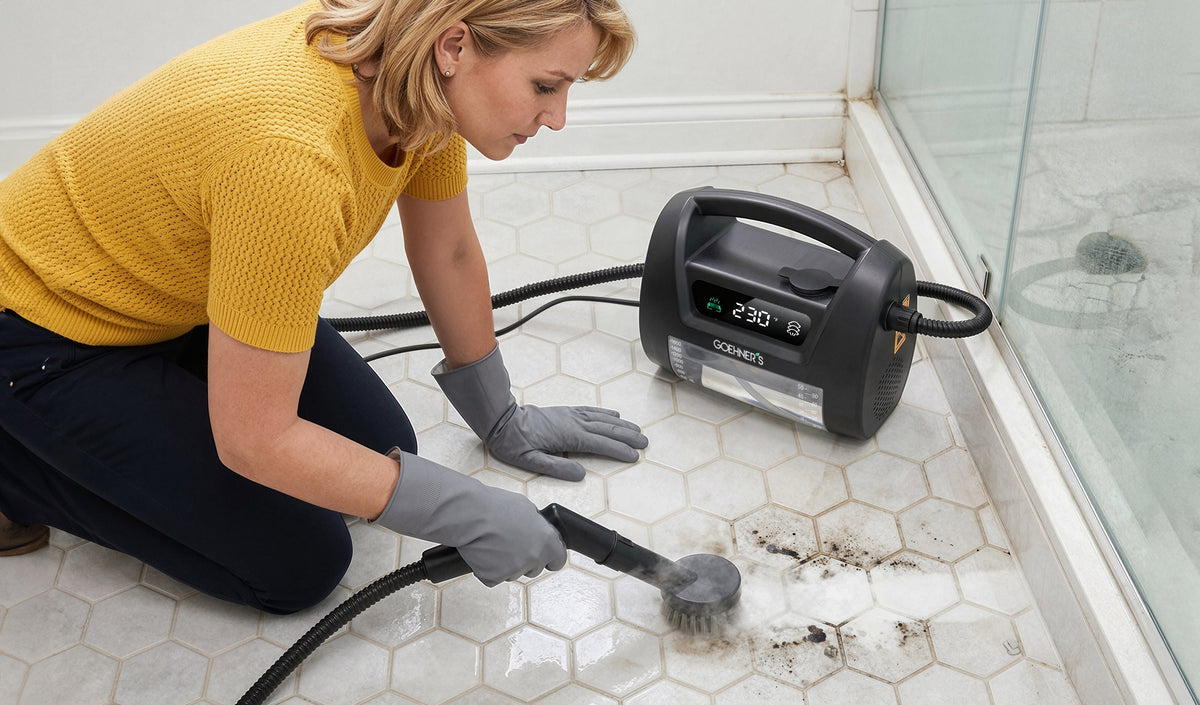
The steam approach: Fill the steam cleaner tank with tap water. Wait about 30 seconds for it to heat. Attach a small bristle brush. Work along grout lines at full pressure with the brush touching the surface — the brush agitates while the steam softens and loosens the grime. Move along the seams in a slow, steady pass.
The steam approach is faster, with far less scrubbing, and there are no fumes, no rinse, and no chemical residue left behind. The grout that bleach tends to leave looking white-gray comes back closer to its original color.
This is the most common reason people pick up a handheld steam cleaner in the first place: the grout result.
Where steam shines as a chemical-free option
• Grout — already covered. Steam reaches into the seam; bleach mostly bleaches the surface.
• Soap scum on glass shower doors — heat softens the calcium-soap-and-oil film so it wipes away, no chemical foam required.
• Toilet seal and base — the grime line where toilet meets floor is awkward to bleach without fumes pooling at floor level. Steam goes in, dirt comes out, no fumes.
• Tile and stone (sealed) — chemical-free means no oxidizer to worry about degrading the sealant.
• Faucets and chrome fixtures — water spots wipe off quickly with no chemical and no hard scrubbing.
• Vent fans and exhaust grilles — a bristle-brush attachment plus steam clears built-up dust without spraying anything into the air you breathe.
Where bleach is still the right tool
To be fair, there are jobs where bleach is the appropriate choice:
• Whitening fabric — steam can't bleach color.
• When a hard surface needs a chemical disinfectant after a known contamination — for known-affected hard surfaces, CDC guidance allows a diluted bleach solution (no more than 1 cup of bleach per gallon of water), with the moisture problem fixed first.
• Treating mold on surfaces you can't safely heat — some painted drywall or old plaster.
For these, use bleach. For most routine bathroom and kitchen cleaning, steam is a chemical-free alternative that's easier on your grout and your air.
The case for moving on from bleach
If you have:
• Children, pets, or anyone with respiratory sensitivity in the home, and you'd rather not spray and breathe chemical fumes
• Grout that keeps darkening despite frequent cleaning
• Tile or stone you'd like to keep sealed long-term
• A bathroom with limited ventilation
• Less time you want to spend on deep cleaning
...then steam is worth a serious look. Not as a miracle cure — as a chemical-free tool that reaches what a surface spray can't, without an oxidizer slowly wearing your grout down.
A handheld steam cleaner with 230°F output and 50 PSI pressure replaces the entire bleach-spray-scrub workflow for most household surfaces. The only ongoing input is tap water. The only ongoing cost is electricity.
Compared with a lifetime of bleach purchases and the fumes that come with them, that's not a close call.
If you're new to the technology, it's worth understanding what dry steam actually is first. And before your first session, we'll be covering what NOT to use a steam cleaner on in an upcoming post in this series — there are a few surfaces (sealed-only stone, certain laminates, unsealed wood) where steam isn't the right call.
---
The workflow above is built around the GOEHNER'S handheld steam cleaner — 230°F output, 50 PSI, ~30-second heat-up, and tap water only. We don't make any disinfection or sanitizing claims for it; this article is about cleaning with heat and water instead of chemistry. Always read your product's safety guide for surface compatibility.
Sources:
• EPA, Mold Cleanup in Your Home and Mold Remediation in Schools and Commercial Buildings (remove vs. kill; bleach not recommended as routine mold practice);
• CDC, mold and chlorine guidance;
• ATSDR, ToxFAQs — Chlorine (respiratory irritant);
• Wikipedia / Chemistry LibreTexts on soap scum composition.


