Boiler Steam vs Flash Steam: Which Fits Your Home?
Spend an hour researching steam cleaners and you'll see two architectures keep coming up: boiler steam cleaners and flash steam cleaners. The names sound technical, but the difference between them is a major factor in how a unit performs — and how often you'll actually use it.
This guide explains what each architecture does, what they're good at, and which one fits a home setting versus a commercial setting.
What "boiler" actually means
A boiler steam cleaner has a pressure-sealed tank with a heating element submerged in the water — the same basic idea as the coil in an electric kettle. You fill the tank, plug in the unit, and wait for the heater to bring the entire tank up to operating temperature. As the water boils, pressure builds inside the sealed tank. When pressure exceeds a release threshold, steam exits through a valve at the nozzle.
This is the same principle as a pressure cooker. The advantage is that boilers can hit high pressures and high temperatures, because the sealed tank lets pressure build up. The disadvantage is that you have to wait for the whole tank to heat up before you can use it, and you have to wait for the whole tank to cool down before you can refill it.
Boiler systems are the older architecture. They come out of industrial steam-cleaning equipment, and they're still the standard in commercial and industrial settings where a longer warm-up isn't a problem and the high pressure is genuinely needed.
What "flash steam" actually means
A flash steam cleaner takes a completely different approach. Instead of pre-heating a whole tank of water, it has a small heating chamber and a water pump that draws water from a separate reservoir into the heating chamber on demand.
When you squeeze the trigger:
• The pump draws a small amount of water into the heating chamber.
• The heater turns that small amount of water to steam almost the instant it passes the hot element.
• The vapor exits through the nozzle at the target temperature and pressure.
• The pump draws more water in to replace what was vaporized.
The result is that the unit is ready to use about 30 seconds after a cold start (the time it takes the heating element to reach operating temperature). There's no pre-heated reservoir, so there's no waiting for a whole tank to come up to temperature.
Flash steam architectures are the newer of the two — they became practical at consumer prices in recent years, as small heating elements and microcontroller-based pump control got cheaper and more reliable.
Why a flash heater warms up faster — and wastes less
Because a flash heater only heats a small, dedicated chamber instead of a whole tankful, it gets to temperature far faster — ready in about 30 seconds versus several minutes for a boiler. It also wastes less energy, heating only the water you actually use rather than keeping a full reservoir hot the whole time you're cleaning.
That's the core trade-off in plain terms: a boiler heats everything in the tank and holds it hot; a flash heater heats only what passes the element, when it passes the element.
Pressure: where the architectures diverge
The clearest difference between the two architectures is the pressure they produce.
Boiler systems, with their sealed pressure tank, can hit higher pressures — that's the architecture you see in industrial degreasing videos, where the jet is strong enough to blast dirt off a surface.
Flash steam systems run at lower pressure, because there's no sealed reservoir to build pressure in. GOEHNER'S Handheld Steam Cleaner runs at 50 PSI.
For most home cleaning, the difference doesn't matter — 50 PSI is enough to lift baked-on cooking grease, dissolved soap scum, and grout grime. But for heavy commercial degreasing (restaurant exhaust hoods, auto-shop floor cleanup), home-grade pressure is too low and you actually need the boiler architecture.
Heat-up time: where flash wins
Commercial boilers take several minutes to heat up. Flash steam cleaners are ready in about 30 seconds from a cold start.
This sounds like a small detail. It's actually one of the things that decides how often you'll use the unit.
A steam cleaner you have to plan for — "I want to clean the bathroom, so let me start the steam cleaner now and wait a few minutes before I begin" — tends to come out of the cupboard rarely. A steam cleaner that's ready by the time you've finished filling the reservoir is the kind you reach for casually, for a five-minute job. Fast-heat-up units simply get used more.
Mid-use refill: another decisive flash win
Boilers can't be refilled while running. The sealed tank is under pressure; opening the cap mid-use vents hot steam violently. You have to power off, wait for the pressure to drop (which means waiting for the boiler to cool), open the cap, refill, and reheat — a long break in the middle of a job.
A flash steam unit avoids the long cool-down entirely. The recommended way to top up is simple: press the power button off, open the pressure-release cap, refill the separate water reservoir, then power back on — you're making steam again in about 30 seconds. Because there's no big tankful of pressurized water to cool, you skip the boiler's long wait. (Always power the unit off and release pressure before opening the cap — never open a cap on a running, pressurized unit.)
For commercial work (where you might run the unit for a long stretch at a time), this matters less because you don't need to refill often. For home cleaning sessions it matters a lot: the topping-up break is short, so your effective working time isn't capped by tank size.
Runtime: depends on which architecture
Boiler tanks are bigger, so runtime is longer when full. But once empty, the long refill cycle cuts into the effective runtime.
Flash steam units pair a modest water reservoir with on-demand heating. A typical handheld holds enough water for a meaningful session, and because the refill break is short, the effective working time isn't strictly limited by tank size. On GOEHNER'S Handheld Steam Cleaner, continuous steam runs roughly 15 minutes on the highest setting and up to about 30 minutes on lower settings before the 1.6 L / 54 fl oz tank needs a top-off — and since a refill is just a brief power-off-and-fill, the practical runtime stays open-ended.
Surface safety: an underappreciated trade-off
This is where the higher pressure of boiler steam becomes a drawback rather than a feature. High-pressure steam will:
• Strip wax off sealed hardwood, leather furniture, and stone counters.
• Drive water into grout cracks faster than the porous material can wick it back out, creating moisture damage.
• Tear delicate fabrics — silk, velvet, fine upholstery.
• Force moisture into electronics — car dashboard heads, instrument clusters, and anything with a small gap a fine jet can work into.
For an industrial environment with concrete floors, stainless-steel surfaces, and no delicate materials, the high pressure isn't a problem. For a home with sealed hardwood, leather sofas, and electronics in every room, it's a constant risk.
Flash steam at 50 PSI is well suited to a wide range of consumer surfaces: sealed hardwood, sealed grout, leather, microfiber, glass, ceramic, sealed stone, vinyl, and most upholstery (laminate is the notable exception — see "What NOT to steam clean"). As always, check the surface manufacturer's guidance and spot-test first.
The right tool for the job
The honest summary is that each architecture is better at what it was designed for.
Boiler steam cleaners are the right tool for:
• Commercial degreasing (restaurant exhaust hoods, fryers, kitchen lines)
• Auto detail shops (engine bays, undercarriage cleaning)
• Industrial cleaning (factory floors, machinery, oil and grease at scale)
• Sustained long sessions, where the longer heat-up is worth it
Flash steam cleaners are the right tool for:
• Home kitchens, bathrooms, and laundry areas
• Car interiors
• Spot cleaning where you might use the unit for five minutes then put it away
• Surfaces that need high heat but lower pressure (sealed hardwood, leather, delicate upholstery)
• Households that will only use the unit if it's ready in about 30 seconds
The category that doesn't fit either bucket
Some of the trickiest products on the market are the cheap pressurized handhelds built like a consumer flash unit (small, light, plug-in) but using a boiler architecture inside (a small sealed pressure tank). They tend to inherit the boiler's downsides without its strengths: you still wait for the tank to heat, you still wait for it to cool before refilling, and the small tank can't hold the high pressure that makes a real commercial boiler useful. They're sold as the cheap entry-level option, but they don't deliver either the convenience of true flash steam or the power of a true commercial boiler — which is a big part of why this corner of the category draws so many disappointed reviews.
The home recommendation
For the large majority of home cleaning use cases, flash steam is usually the better fit. The deciding factors aren't raw pressure (which boilers win) — they're heat-up time, refill convenience, and surface compatibility. Those three add up to "the unit actually gets used regularly."
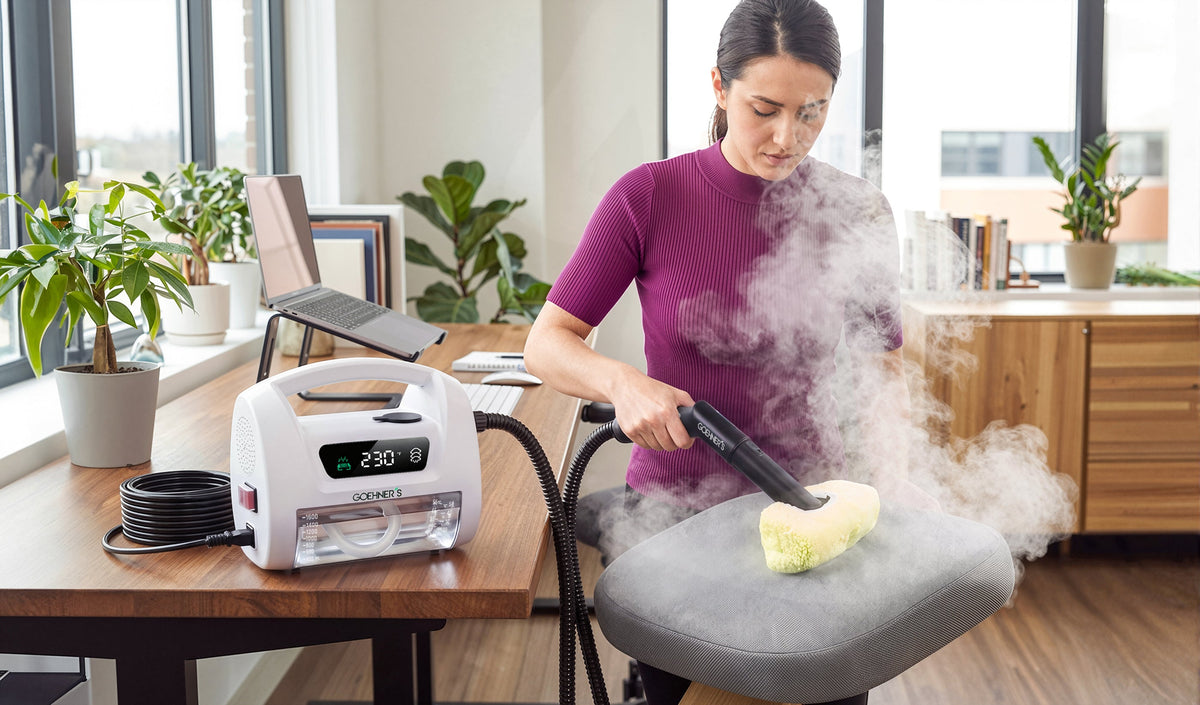
The GOEHNER'S Handheld Steam Cleaner is a flash steam unit — flash heater with dual-PWM control, an ~30-second cold-start heat-up, a short power-off-and-refill instead of a long cool-down, and 50 PSI with 230°F / 110°C dry steam at the nozzle. It's the architecture, not the marketing, that determines whether a steam cleaner becomes a habit in your house.
If you want to go deeper on the steam itself, see What is Dry Steam? and What Is PWM Steam Control. A later guide in this series breaks the category down by price tier — what you get at each level and where this product sits.
---
For full commercial-grade pressure, you need a boiler unit. Below that, flash steam delivers what most home users actually need.


