Dry Steam vs Wet Steam: The Physics That Matters
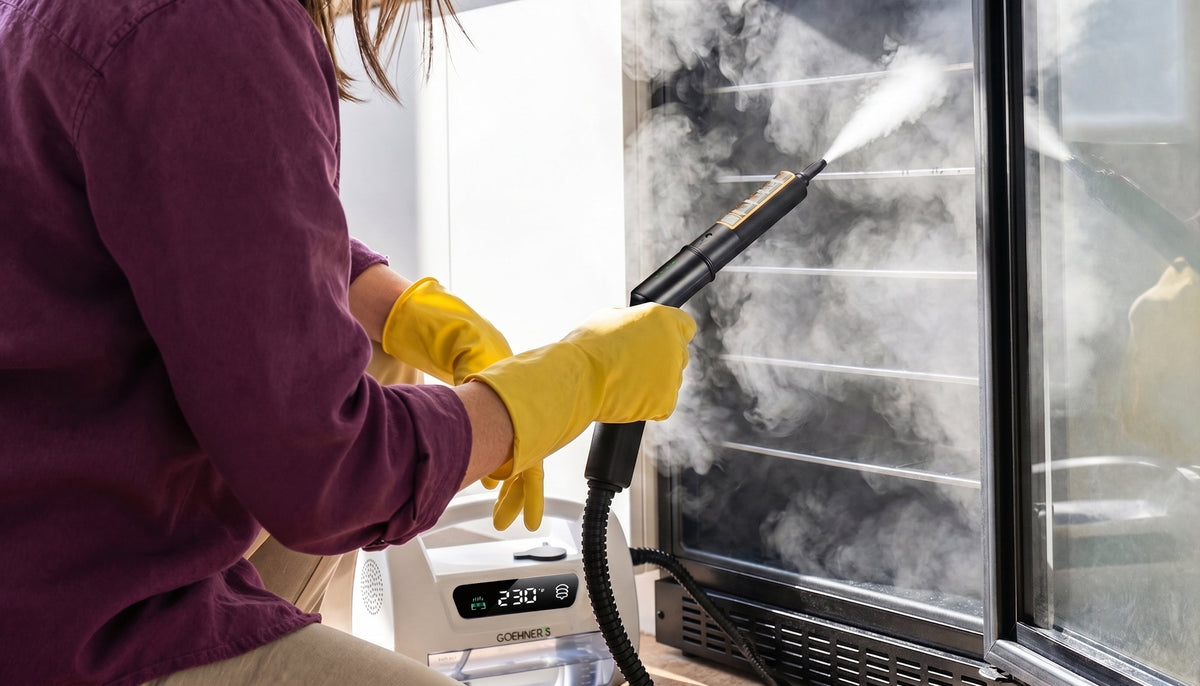
The short version: What separates wet from dry steam is moisture content, not temperature. Drier steam carries far less liquid water, releases more latent heat per puff, and is safer on sealed hardwood and electronics. The Goehner's Handheld Steam Cleaner uses a boiler-free flash heater and dual-PWM control to produce drier steam, measured at roughly 230°F / 110°C at the nozzle.
The marketing copy for steam cleaners glosses over the most important distinction in the category: not all "steam" is the same. The difference between wet and dry steam isn't a minor variable — it's a big factor in whether you can safely clean hardwood floors, electronics, leather furniture, or anything porous.
This article goes one level deeper than our buyer's guide on dry steam, "What is Dry Steam? A First-Time Buyer's Guide". Here we're getting into the basics — saturated vs superheated vapor, latent heat, and why the moisture content of steam matters more than the temperature.
Does temperature tell you if steam is wet or dry?
No — steam at 212°F can be either wet or dry, depending on how much liquid water it carries; temperature alone doesn't tell you which.
At sea level, water boils at 212°F (100°C). At that temperature, liquid water turns into steam — a colorless gas. The transition is called "saturation": at exactly 212°F at normal atmospheric pressure, liquid water and steam coexist together.
Now — and this is the key point — "steam at 212°F can be either wet or dry, depending on how much liquid water it carries". The temperature alone doesn't tell you which.
Three states are possible at 212°F at sea level:
Saturated wet steam: steam mixed with liquid water droplets. Some of the mass is still liquid, not vapor.
Saturated dry steam: steam with very little liquid component — almost all vapor. This is what good steam cleaners aim for.
Superheated steam: steam that has been heated above its boiling point. At normal atmospheric pressure, anything hotter than 212°F is superheated. The vapor is fully dry and carries extra heat.
When products advertise "dry steam", they're typically describing steam that is close to all-vapor — with much lower liquid moisture content than wet steam. Worth being honest about: drier does not mean "no" water. Any steam will still condense into visible water if you aim it at a cold surface like glass or metal, or hold it on one spot. That's just physics, and it's true of every steam cleaner.
Why does a boiler-free flash heater help?
The pressure matters because it sets the steam's temperature. At normal air pressure, steam cannot get hotter than about 212°F / 100°C. Sealing the system and letting pressure build (the GOEHNER'S Handheld Steam Cleaner runs about 50 PSI / 3.4 bar) raises that ceiling, so the steam leaves the nozzle at 230°F / 110°C instead. In the GOEHNER'S Handheld Steam Cleaner this happens in a boiler-free flash heater: a separate reservoir feeds water on demand into the heating chamber, where it flashes to steam on contact — the water is not stored and simmered in a tank.
Inside the GOEHNER'S Handheld Steam Cleaner's heating chamber, the system meters water in only as fast as the heater can fully vaporize it, so the vapor leaving the chamber is high-quality — close to all vapor, with very few entrained droplets.
When the vapor exits the nozzle, pressure drops back to ambient and the plume expands. By the time it reaches the surface being cleaned, it's a steady, drier-steam plume at roughly 230°F / 110°C with low moisture content — the result the unit is built to deliver.
This is why the GOEHNER'S Handheld Steam Cleaner produces dry steam, not wet steam. The dual-PWM control system is what keeps it stable: it meters how much water enters the flash heater so the heater can keep up. Because the tank and heater are separate, you can also refill anytime without waiting for it to cool — just release pressure via the cap first.
Why does steam clean so effectively?
Here's the reason steam cleans so effectively. When steam contacts a cooler surface, it condenses back to liquid water. That phase change "releases a large amount of energy" — about 2,257 kJ per kilogram of water at atmospheric pressure (compared to roughly 80 kJ per kg released when liquid water cools by 20°C). That figure is a standard physical constant, not a marketing number.
That energy is what heats the surface, softens grease and grime, and lowers its viscosity so it loosens from the surface. Steam cleaning is mainly a heat process, and the latent heat of condensation is what makes it more effective than just hot water at the same temperature.
Dry steam releases more latent heat per puff than wet steam, because dry steam has more vapor left to condense. Wet steam has already partly condensed (those are the droplets), so there's less heat per pulse. This is one reason dry steam tends to clean faster: more heat reaches the surface per second.
Why does moisture content matter for hardwood floors?
Wet steam deposits more liquid water that can work through the finish and swell the wood; drier steam deposits much less, which lowers that risk.
Sealed hardwood has a finish (usually polyurethane) on top of the wood. That finish is meant to resist water — but it only "slows" moisture, it doesn't completely stop it. Two things determine whether steam can damage a hardwood floor:
1. How much moisture lands on the surface. Wet steam deposits more liquid water. If water sits on one spot, given enough time it can work through micro-cracks in the finish and the seams between boards, reach the wood underneath, and swell the fibers — which lifts the finish from below.
There's no published "safe number of seconds" for this. Major flooring authorities don't give a stopwatch threshold; they treat steam and standing water as a moisture-intrusion risk to avoid. The National Wood Flooring Association advises against steam mops on wood floors, warning they "will damage the finish and the wood over long periods of time." The honest physics is that risk tracks how long moisture sits in one place and how much of it there is.
Dry steam deposits much less liquid water — a lot of what condenses evaporates back into vapor soon after contact, because the surface is warm and the surrounding air can take up the moisture. The smaller amount that does get through is less likely to swell the wood noticeably.
2. Dwell time. Moving steadily and wiping up moisture right away keeps contact time short, so little gets through. Letting steam linger on one spot lets it accumulate. The practical implication: "drier steam at a moving-pass speed is far safer on sealed hardwood than wet steam held in one place." The same unit, used differently, gives different results.
Why does moisture content matter for electronics?
Wet steam delivers droplets that can collect inside a housing and start corrosion; drier steam delivers almost no droplets, so net moisture buildup inside stays very low.
Modern electronics (car dashboards, kitchen appliances, anything with circuit boards under cosmetic covers) are usually splash-resistant, not waterproof. Steam can get past that.
Wet steam delivers moisture in two forms: vapor, which can seep through seams and condense inside the housing, and droplets, which get through seams as liquid and collect inside. The droplets are the bigger problem — once liquid water is inside a sealed enclosure, it can't easily escape, and corrosion can start.
Dry steam delivers almost no droplets. Some vapor can still seep through seams, but with far less liquid water involved, the small amount inside tends to stay as vapor and works its way back out as the air around it dries. Net moisture buildup inside the enclosure stays very low.
The practical implication: "drier steam is much safer on car dashboards and vent fins; wet steam can drive liquid water into the instrument cluster and head-unit screen." As always with electronics, keep the steam moving, use a cloth over the nozzle for delicate areas, and never soak one spot.
Why does a little water come out on restart?
If you stop mid-job and pick the unit back up 10–30 minutes later, the first thing out of the nozzle may be a little water rather than clean steam. That's normal physics, not a leak or a fault: steam left sitting in the hose cools and condenses into water, and the first burst of fresh steam pushes that condensate out.
Quick tip: on restart (or any time the nozzle has cooled), aim it at a rag or into a sink and trigger it for a second or two until you see a steady, drier plume before going back to the surface you're cleaning. It's the same condensation principle this whole article is about — steam turns back to water whenever it hits something cooler than itself.
How can you tell drier steam apart before you buy?
The proxy signals covered in our buyer's guide, "What is Dry Steam? A First-Time Buyer's Guide":
Flash heating + PWM control: These regulate water input precisely enough to let the heater fully vaporize it.
A 230°F / 110°C output measured at the nozzle: reaching that only takes ~50 PSI of pressure — at plain atmospheric pressure steam tops out near 212°F, so a stable, hot output at the nozzle is part of the picture (though temperature alone isn't the whole story).
Steady output, not sputtering: Units that surge and spit are throwing droplets — a sign of wetter steam.
Reviews that mention "dries fast" or "no water spots": Both are downstream signs of lower moisture content.
We dig into the control system that makes this possible in another article in this series on PWM steam control — see our News blog for it.
So what matters more — temperature or moisture content?
Moisture content matters more than peak temperature. A unit that hits 230°F with wet steam is more likely to leave hardwood wet and drive moisture into electronics; a unit that hits 230°F with drier steam is safer on both — as long as you keep it moving and don't soak one spot.
The difference between wet and dry steam is real and is something a steam cleaner is designed around — not just marketing. The GOEHNER'S Handheld Steam Cleaner uses a boiler-free flash heater, dual-PWM control, and a 230°F / 110°C output at the nozzle to produce dry steam. The same basic principles separate it from cheaper handhelds that pool water in a heated reservoir and tend to produce wetter steam.
---
The physics described above (saturation, latent heat of vaporization ≈ 2,257 kJ/kg) is standard thermodynamics, consistent with published steam tables. Flooring guidance is from the National Wood Flooring Association (woodfloors.org/maintenance), which advises against steam mops on wood floors. Note: GOEHNER'S Handheld Steam Cleaner is a handheld home unit (230°F / 50 PSI), not an industrial dry-vapor machine — we don't claim industrial-grade specs.


