Steam Cleaner Tiers: Cheap, Mid-Range, or Commercial?
Steam cleaners exist at wildly different price points — anywhere from $50 on Amazon to $3,000+ in industrial supply catalogs. The product reviews in each tier aren't telling you what the next tier up offers, or whether it's worth it. So when a first-time buyer shops without context, they typically default to the cheapest option, regret it, and often end up either giving up on steam cleaners entirely or replacing it with the next tier up later.
This guide cuts the category into three tiers, explains who each tier is built for, and helps you figure out which one fits your home before you spend the money.
Tier 1: $50–100 — Pressurized Boiler Handhelds
This is the most populated tier on Amazon — dozens of OEM-sourced brands, all selling structurally similar products. They look like flash steam handhelds (small, light, plug-in) but use a small pressurized boiler architecture internally.
Typical specs (these are advertised figures, sampled across listings in May 2026; lower-tier listings frequently overstate them, so treat them as marketing numbers rather than verified performance):
• Heating method: small sealed boiler tank, heated until pressure builds
• Tank size: roughly 250 mL on pistol-grip models, up to 1.6 L on the larger box-and-hose style
• Steam pressure: most listings don't publish a number; the few that do claim around 3–3.5 bar / 44–51 PSI
• Power: advertised anywhere from ~1,050 W to 2,500 W — but the high figures are often inflated (in one sample of 16 budget listings, 9 claimed 2,500 W, which is implausible for a handheld of this size)
• Heat-up: advertised at anywhere from 15 seconds to 4 minutes (the 15-second claims should be read with the same skepticism as the wattage claims)
• IP rating: rarely stated on these listings
• Warranty: 1 year or none
A real-world note from our own sampling: cords advertised at 13 ft have measured noticeably shorter on some units, and several listings sell what reviewers describe as a warm mist rather than true steam. The numbers on the box and the experience in your hand often don't match.
What they're actually good at: light, water-soluble residue. Fresh soap scum on a shower door, recent limescale on a faucet, fresh wipe-downs of a kitchen counter. If the dirt is mostly water-soluble and not stuck on, these units will handle it.
What they struggle with: baked-on cooking grease (which needs sustained high temperature at the nozzle that these units can't hold once the boiler starts emptying), grout (which needs pressure driven into the pores), and any longer session (sputtering tends to kick in as the small tank runs low).
Who they're for: Someone who'll use it for occasional light cleaning, accepts the warm-up wait and the sputtering as part of the trade-off, and treats the unit as semi-disposable.
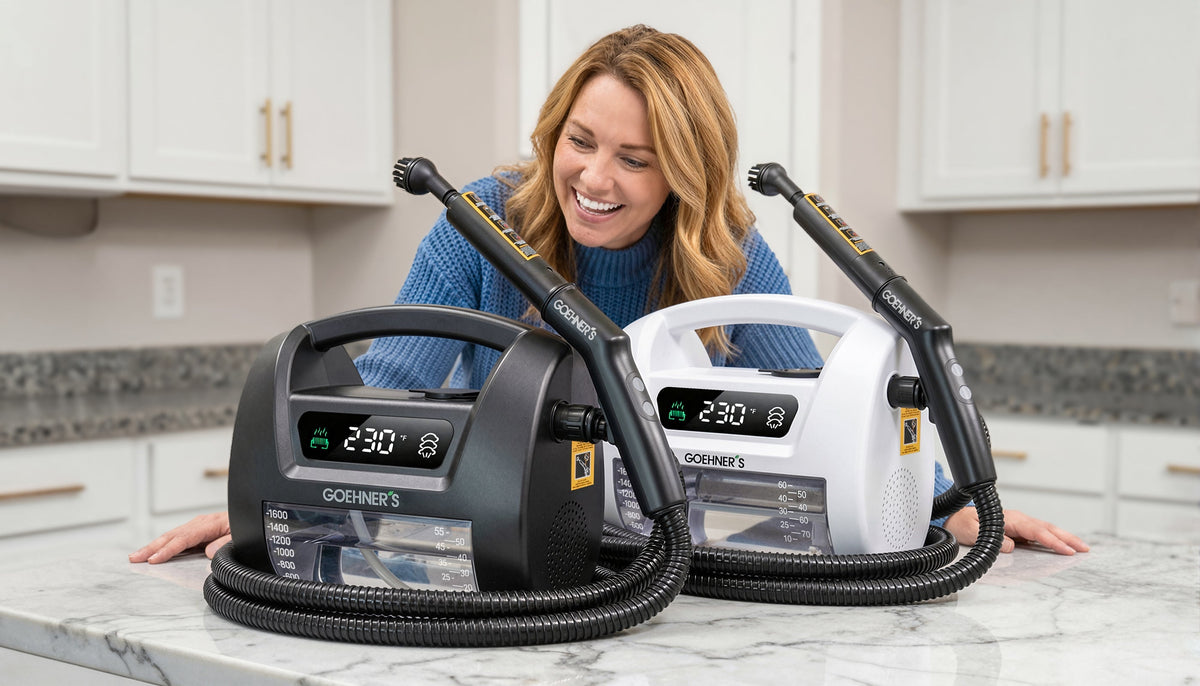
Tier 2: $100–250 — Flash Steam Handhelds (where GOEHNER'S sits)
This is the newer category — flash steam architecture (water heated on demand, not pre-stored in a pressure tank), with consumer-grade power output. The technology has become practical in recent years as small heating elements and microcontroller-based pump control have gotten cheaper.
Typical specs:
• Heating method: boiler-free flash heater + dual-PWM (water-pump PWM + PID-fed heater PWM)
• Steam type: dry steam (much lower moisture content than wet steam — not "no water"; aimed at a cold surface or held in one spot, any steam still condenses)
• Steam pressure: 50 PSI, held constant
• At-nozzle temperature: 230°F / 110°C, held steady
• Power: 1,800 W (110V·60Hz US, or 220–230V·50Hz EU)
• Heat-up: about 30 seconds from cold (5–10 seconds on a warm restart)
• Continuous runtime: ~15 min on the highest setting, up to ~30 min on lower settings, no sputtering
• Refill: power off, top up the reservoir, power back on — steaming again in about 30 seconds, no long cool-down
• Build: IP67 sealed handle, capacitive trigger, sealed body, 13.2 ft power cord + 5 ft hose (~18 ft total reach), 6 accessories plus a funnel
• Warranty: 3 years (5-year for orders placed within 60 days of launch)
What they're good at: kitchens (stovetops, range hoods, oven interiors, sealed countertops, sealed tile), bathrooms (grout, soap scum, fixtures, glass shower doors), car interiors (vents, upholstery, dashboard), and laundry (mattresses, curtains, upholstered furniture). Designed for the full range of home cleaning scenarios, using nothing but heated water — no chemicals.
What they struggle with: heavy industrial-grade grease (restaurant exhaust hoods that haven't been cleaned in months), unsealed grout (any steam will saturate it), unsealed hardwood (any steam can warp it), and pressure-washing tasks (low-pressure dry steam won't blast off stuck-on mud or paint splatter — that needs a real pressure washer).
Who they're for: Households that want a chemical-free cleaning tool that actually gets used regularly. The ~30-second cold-start heat-up — and being able to power off, refill, and be steaming again in about 30 seconds instead of waiting for a boiler to cool down — is what turns this tier into a daily/weekly habit rather than a once-a-month chore.
Tier 3: $1,500–3,000 — Commercial Boiler Units
Industrial dry-vapor steam systems used in restaurants, auto shops, food processing facilities, and healthcare settings. Built around a large pressure tank with a high-wattage heating element and a serious pump.
Typical specs (drawn from published manufacturer specifications for commercial models such as Reliable, Dupray, Daimer, Ladybug, and Steamericas):
• Heating method: boiler tank with pump and pressure regulator
• Steam pressure: roughly 75–138 PSI (about 5–9.5 bar) — for example, 87 PSI on the Reliable Brio Pro 1000CC, 121 PSI on the Dupray Hill, 138 PSI max on the Steamericas Optima XD
• At-nozzle temperature: roughly 260–345°F at the spray tip (boilers can run higher internally, in the 320–352°F range)
• Tank size: from about 2 L on smaller units up to 36 L on large industrial models
• Heat-up: several minutes to fully pressurized (e.g., ~7 min on the Brio Pro, ~15 min on the Daimer 300CS)
• Power: roughly 1,600–1,750 W on the electric commercial units
• Weight: from about 13 lb up to 200+ lb, typically on wheels (handheld nozzle connected by hose to a wheeled unit)
• Price: roughly $1,700–$2,900+ for electric commercial models; large industrial/diesel units are quote-only
• Warranty: 1–2 years commercial
What they're good at: heavy-duty industrial-grade tasks. Restaurant fryer-line cleaning, exhaust hood degreasing, auto-shop engine bay cleaning, large-area facility cleaning. Anywhere you genuinely need 100+ PSI of pressure and very hot steam for an hour at a time.
What they're not for: home use. They're too heavy to carry, too aggressive for sealed home surfaces, take too long to heat up for casual use, and cost more than most people want to spend on a cleaning tool.
Who they're for: commercial cleaning services, restaurants, auto detail shops, factories. Not households.
The 5-question framework for picking a tier
Before you spend any money, answer these five questions:
1. How often will you actually use it?
• Twice a year, for one specific task → Tier 1 ($50–100).
• Every week or two, for general home maintenance → Tier 2 ($100–250).
• Every day, for hours at a time → Tier 3 ($1,500+) — and you're probably running a business.
2. What surfaces will you clean?
• Just light surface dirt on glass and ceramic → Tier 1 is fine.
• Grout, kitchen grease, soap scum, upholstery, car interiors → Tier 2.
• Industrial grease, large surfaces, oil-soaked machinery → Tier 3.
3. How much do you care about heat-up time?
• Don't mind waiting a few minutes before using → Tier 1 is fine.
• Want the unit ready in about 30 seconds or you won't use it → Tier 2 is the only option (commercial units take several minutes to pressurize).
4. Are there sealed hardwood, leather, or delicate surfaces in your home?
• Yes → Tier 2 (50 PSI dry steam is gentler on these surfaces than 100+ PSI commercial steam, which may be harsher on wax finishes and leather). Always spot-test first and follow the surface manufacturer's guidance.
• No, just industrial surfaces → Tier 3 if budget allows.
5. What's your budget?
• Under $100 → Tier 1, knowing what you're getting.
• $100–250 → Tier 2, the price point most home users land at.
• $1,500+ → Tier 3, almost always a business expense.
Why the tiers cost what they cost
Why does a well-engineered flash steam handheld sit at $100–250 rather than down at Tier 1 prices? It comes down to what's inside, and what that buys you in everyday use:
• A flash heater instead of a basic boiler element — water turns to steam on demand, so the unit is ready in about 30 seconds and you skip the wait-for-pressure cycle.
• A PWM-controlled pump instead of a fixed-output one — steam output stays steady across the session instead of surging and sputtering as a small tank drains.
• A microcontroller-based control board instead of a simple analog one — it holds the temperature steady around 230°F rather than drifting as the unit runs.
• An IP67 sealed handle instead of an unsealed plastic one — built to shrug off the moisture it's working in.
Those are stronger, more deliberately engineered components, and they're a real reason the mid-range costs more than the cheapest units. They're also the reason the experience is different: faster to start, steadier in use, and built to last longer.
What you don't pay for in Tier 2 — compared to Tier 3 — is the industrial-grade boiler, the large pressure-rated tank, the heavy-duty wheels, and the commercial certification rigor. Those are real costs that legitimately add a thousand dollars or more to a commercial unit's price, but they're things you simply don't need for cleaning at home.
The honest recommendation
If you're shopping for home use and aren't sure which tier to start with, Tier 2 is almost always the right call. Tier 1 is often false economy — you may buy it, find it doesn't keep up, and replace it with Tier 2 sooner than you'd like. Tier 3 is overkill — you'll spend $1,500+ on a tool that's harder to use than a Tier 2 unit for the tasks you actually do at home.
The $100–250 range — where flash steam handhelds sit — is the sweet spot for households that actually want to use the thing. The GOEHNER'S Handheld Steam Cleaner sits at the entry of this tier (1,800 W, 50 PSI, 230°F, ~30-second heat-up, 13.2 ft cord + 5 ft hose, 6 accessories plus a funnel), offering competitive features at a lower price than most of the tier — check the current price on the product page.
For a deeper look at the two architectures behind Tier 1 and Tier 2, see Boiler Steam vs Flash Steam. If you're still narrowing down a specific model, How to Choose a Handheld Steam Cleaner: 7 Specs walks through the spec sheet. A later post in this series looks at whether a handheld steam cleaner is worth it for your home at all.
---
Tier definitions are approximate and reflect general market pricing patterns in the US consumer steam-cleaner market as of 2026. Tier 1 figures are advertised specs sampled in May 2026 and are frequently overstated; Tier 3 figures are drawn from published manufacturer specifications. Commercial models vary widely in spec depending on application.


