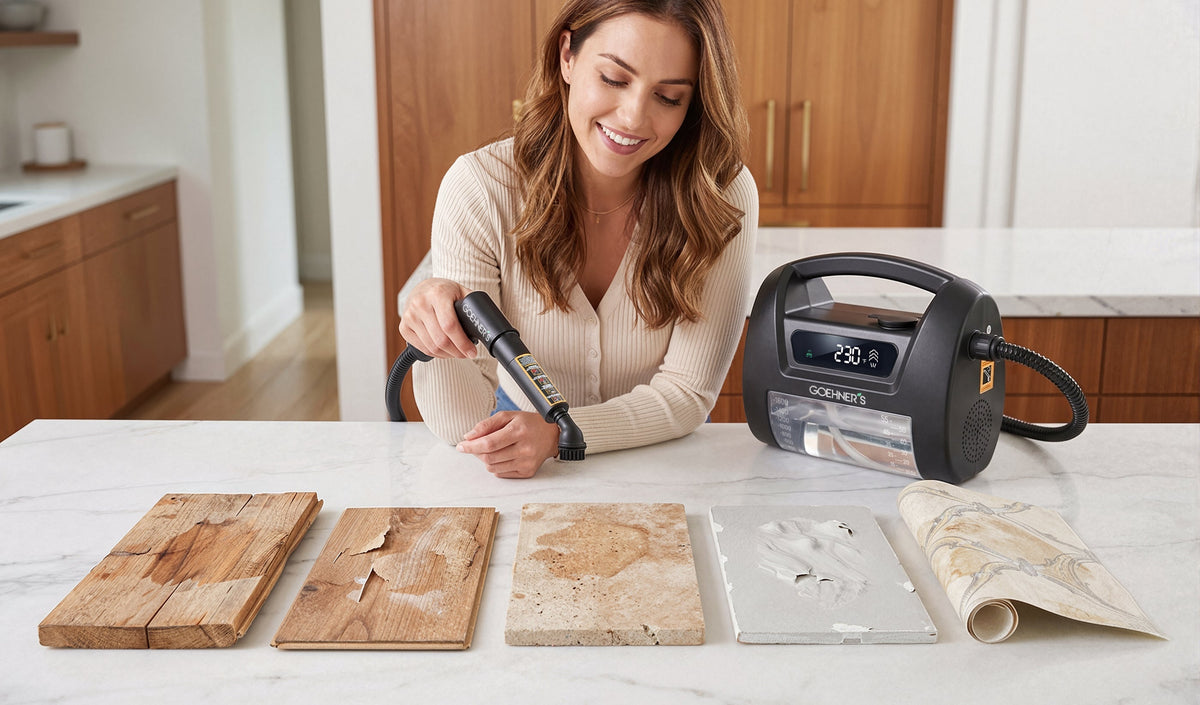
What NOT to Use a Steam Cleaner On (And Why)
A good steam cleaner feels close to magic the first week you own one. Baked-on grease, grout you had given up on, the inside of an oven door — all of it lifts with hot vapor and a microfiber bonnet, no chemicals required. So it is tempting to point the nozzle at everything in the house and see what happens.
Please do not do that.
A steam cleaner is a precision tool, not a universal one. Knowing where it should not go is just as important as knowing where it shines — and honestly, a brand that only tells you the first half is not being straight with you. So here is the second half: the surfaces that can be damaged by steam, the science behind why, and how to handle the borderline cases without ruining anything you care about.
Almost every "do not steam this" rule comes down to two failures
Before the list, it helps to understand the framework. There are really only two ways steam damages a surface, and once you can name them, every example below makes intuitive sense.
• Heat damage. The vapor leaving the nozzle is hot — on the GOEHNER'S SteamVex it exits at 230°F / 110°C. Most household materials handle that fine. Some do not. Thin plastics soften and warp, certain finishes blister, and materials under thermal stress can crack.
• Moisture damage. Steam is still water. It is less water than you might think — more on that later — but it is not zero. Anything porous, anything that swells when wet, anything held together by a water-soluble adhesive is vulnerable. The moisture works its way into seams, fibers, and cores where it does not belong.
Every off-limits surface below fails because of one or both of these. Keep that in mind as you read, and you will be able to make a smart call even on a material we did not specifically list.
Surfaces to avoid — or treat with real caution
Unsealed or waxed hardwood and untreated wood
This is the big one, because so many people buy a steamer specifically for floors. Sealed, finished hardwood in good condition is generally fine for a quick pass with a microfiber bonnet. Unsealed, waxed, or oiled wood is not.
The mechanism is moisture damage. Wood fibers absorb water and expand. Push steam into an unsealed plank and the surface fibers swell, lift, and can cup or crown — that slight warp you see across a board. Waxed finishes are worse: heat softens the wax and steam clouds it. If you are not certain your floor is sealed and in good shape, treat it as unsealed and skip the steam.
It is worth being precise about why, because the internet is full of made-up numbers like "steam ruins wood in 30 seconds." There is no published "safe number of seconds." The real risk is how long moisture is allowed to sit in one spot: a polyurethane finish slows, but never prevents, moisture from reaching the wood, so the longer steam lingers on a single area, the more of it works through the film and seams into the wood. Keep moving and wipe up, and contact time stays short. In fact, the National Wood Flooring Association advises against steam mops on wood floors altogether, warning they "will damage the finish and the wood over long periods of time." That is the honest framing — a cumulative moisture risk, not a stopwatch rule.
Laminate and engineered flooring — especially older seams
Laminate looks like it should be tough. It is not, where steam is concerned. Laminate is a printed wear layer over a fiberboard (MDF or HDF) core. That core is essentially compressed wood pulp, and it is extremely thirsty.
As long as the planks are new and tightly sealed, surface steam mostly stays on the surface. But seams loosen with age and foot traffic. Steam under pressure finds those gaps, reaches the fiberboard core, and the core swells from the inside. The result — edges that puff up, lift, or "peak" — is usually permanent. Some laminate manufacturers explicitly void their warranty if you steam the floor. Check yours before you assume.
Unsealed natural stone and cracked grout
Sealed stone tile and intact grout are great steam candidates. Unsealed marble, slate, travertine, and any grout with hairline cracks are not. Natural stone is porous, and unsealed grout is even more so. Steam drives moisture down into those pores and cracks, which over time can worsen the cracking and, with some stone, leave a dull or etched look. If you are not sure whether your stone is sealed, a quick water-drop test tells you: water that beads is sealed, water that darkens the stone is not.
Painted drywall and water-based paint
Steam can soften and lift paint, especially water-based latex paint on drywall, which is most interior walls in a typical home. Hold a steam nozzle on a painted wall and you can watch the film bubble and peel. Spot-clean a scuff with a damp microfiber cloth instead, and keep the steam well away from the wall.
Wallpaper
Steam is the tool professionals use to remove wallpaper. The adhesive behind it is water-activated, and steam reactivates it. Point a steamer at a wallpapered wall and you are, very efficiently, beginning a removal project you did not plan. Skip it entirely.
Delicate fabrics
Steam refreshes a lot of upholstery beautifully — but not all of it. Be cautious with silk, some velvets, anything labeled dry-clean-only, and thin synthetic fibers that can melt or pucker under heat. The two failure modes both apply here: heat can deform synthetics, and moisture can leave water marks or rings on fabrics that do not dry evenly. For any fabric you do steam, fit a microfiber bonnet onto the brush head so the cloth — not the bare nozzle — touches the fibers: it buffers the heat and lifts moisture as you go. Always check the care tag, and always test a hidden spot first.
Large, cold panes of glass
Cleaning a small mirror or a shower screen with steam is fine. A big window on a cold winter day is a different story. Glass under a sudden temperature swing experiences thermal stress, and a large cold pane hit with 230°F vapor can — in the worst case — crack. If you want to steam-clean exterior or large windows, do it on a mild day, warm the glass gradually rather than blasting one spot, and keep the nozzle moving.
Electronics and circuit boards
Never aim steam directly into electronics. Steam pressure does exactly what you do not want here: it drives moisture into seams, vents, and gaps and pushes it deep enough to reach components. You can absolutely steam-clean around electronics — the dusty exterior of a console, the area around a car's infotainment screen, a keyboard's outer shell — but clean near them, not into them. Keep the nozzle off the seams, use the lowest setting, and let the microfiber bonnet do the work close to the device.
Cardboard, paper, and anything that disintegrates when wet
This one is intuitive but worth stating. Cardboard, paper, paper crafts, and similar materials simply fail when they get wet. There is no safe technique — just keep steam away from them.
Thin, heat-sensitive plastics
Many household plastics are fine. Thin, low-temperature plastics are not. The risk is heat damage, and it is worst when the nozzle lingers. A quick pass may be survivable; holding steam on one spot lets heat build until the plastic softens and deforms. When in doubt, test an inconspicuous edge, keep moving, and never park the nozzle.
So can you ever clean these delicate surfaces?
Often, yes — "avoid" rarely means "never touch." It means slow down and respect the two failure modes. For borderline surfaces, this is the safe routine:
• Test a hidden spot first. Pick somewhere invisible — under furniture, inside a cabinet edge, the back of a cushion — and steam it. Wait, let it dry, and check for warping, clouding, discoloration, or lifting before you commit.
• Use the lowest steam setting. Less vapor means less heat and less moisture per pass. For anything delicate, start low.
• Put a microfiber bonnet between the steam and the surface. A polishing bonnet does two useful things at once: it spreads the heat so no single point gets blasted, and it absorbs moisture so less of it reaches the material. For delicate work, the bonnet is not optional.
• Keep moving — never park the nozzle. Almost all heat and moisture damage comes from holding steam in one place. There is no magic number of seconds; the danger is cumulative dwell time on a single spot, so a continuous, moving pass is far safer than holding the steam still.
• Let it dry fully afterward. Give the surface real time to dry before you replace furniture or rugs. Trapped residual moisture is its own slow problem.
Where the GOEHNER'S design helps — and where it does not
A couple of features on the SteamVex make the careful approach easier. It has three steam levels, so you genuinely can dial down to the lowest setting for delicate surfaces instead of being stuck on one fixed output. It ships with microfiber polishing bonnets, which are exactly the heat-spreading, moisture-absorbing buffer described above. And because it produces dry steam — vapor with a noticeably lower water content than the wetter output of many low-cost steamers — it is somewhat more forgiving on moisture-sensitive surfaces. If you want the physics of that, we cover it in Dry Steam vs Wet Steam: The Physics.
Here is the honest part, though: dry steam reduces moisture, it does not eliminate it. Dry steam is still steam, and steam is still water and heat — on a cold surface, or held in one spot too long, it will still condense into liquid water. No feature on any machine overrides the manufacturer's instructions for your floor, your fabric, or your stone. The test patch always wins over the guess.
If you want to dig further into where steam genuinely excels instead, Chemical-Free Deep Clean: Steam vs Bleach covers the surfaces it was practically made for.
The honest takeaway
A steam cleaner is a precision tool. Used on the right surface with the right setting, it replaces a cabinet full of chemicals and a lot of scrubbing. Used as a point-and-blast gadget, it can warp a floor or peel a wall.
The two questions to ask before you steam anything new are simple: Can this material handle the heat? Can it handle the moisture? If you are not sure of both answers, test a hidden patch first. That five-minute habit is the difference between a tool you trust and an expensive lesson.
A note on this list: it covers the common cases, not every material on earth. When you meet a surface we did not name, fall back on the framework — heat damage and moisture damage — and the hidden test patch. Those two things will not steer you wrong.
Sources:
• National Wood Flooring Association (woodfloors.org/maintenance)
• USDA Forest Products Laboratory (guidance via NOFMA)
Note: Both organizations treat steam as a moisture-intrusion risk to avoid, and neither publishes a "safe seconds" threshold.


