What Is Dry Steam? A First-Time Buyer's Guide
The short version: Most product pages just say "steam," but the kind matters. Dry steam carries much less liquid water than wet steam, so it cleans with heat while leaving surfaces less wet — which means faster drying and more margin on moisture-sensitive surfaces like hardwood and grout. "Dry" means low-moisture, not no-moisture. The Goehner's Handheld Steam Cleaner produces dry steam.
Walk down the cleaning-appliance aisle of any big-box store, or scroll through Amazon's steam-cleaner category, and you'll see the same word stamped on most product pages: "steam." What you won't see — but what makes a real difference once you start using one — is what kind of steam.
There's wet steam. There's dry steam. There's "superheated steam," which is its own thing. The terms get used loosely, sometimes interchangeably, and that's a problem if you're spending $100–300 on a unit and you don't know which one you're actually buying.
This is a buyer's guide for understanding the category, not the marketing.
What is dry steam, and how does it differ from wet steam?
Dry steam carries much less liquid water than wet steam, so it leaves the surface less wet and drying faster; wet steam mixes in more liquid droplets that puddle and soak in. Here's the physics in plain English.
Water boils at 212°F (100°C) at sea level. At that point, it changes from liquid to gas — steam. Pure steam is a colorless gas. The white "steam" you see coming out of a kettle isn't actually steam; it's tiny droplets of water that have already condensed back out of the gas as soon as it hits cooler air.
Here's where the different terms come from:
Wet steam is steam mixed with a meaningful amount of liquid water droplets. Many cheap consumer steam cleaners produce wet steam, because the heating chamber is too small relative to the water flow rate — water gets pushed out before it has fully turned to vapor. The tell isn't really the plume — every steamer puts out a visible plume — it's that wet units tend to spit liquid water droplets along with the steam and leave the surface wetter.
Dry steam (also called "dry saturated steam") is steam that carries much less liquid water along with it. You'll still see a steam plume from the nozzle — dry steam is visible, like any steam — but it spits far less liquid water, so the surface ends up with less water sitting on it and dries noticeably faster after cleaning. Important honesty check: "dry" does not mean "no water." Dry steam still carries moisture, and if you aim it at a cold surface like glass or metal, or hold it on one spot, it will condense back into visible water droplets — that's just physics, and it happens with any steam.
Superheated steam is steam that has been heated above its boiling point at a given pressure, and it's mostly used in industrial cleaning and processing systems. Most home units don't go this far. Goehner's Handheld Steam Cleaner produces dry steam, not superheated.
The single most important takeaway: "steam" on a product page tells you almost nothing. The question is whether it's wet or dry, and that's rarely advertised.
Why does dry steam work better than wet steam on home surfaces?
If wet and dry steam both leave the nozzle at 230°F, why does dry steam tend to work better? Two reasons.
1. Surface moisture gets in the way of heat transfer. When wet steam hits a surface, the liquid droplets puddle. That puddle sits between the rest of the incoming steam and the dirty surface, so the dirt underneath doesn't get the full benefit of the heat. Dry steam leaves a thinner film that evaporates faster, so the next pulse of vapor reaches the surface more directly.
2. Wet steam soaks porous surfaces. Grout, sealed wood, fabric upholstery, and unsealed stone all absorb the liquid component of wet steam. That liquid carries dissolved minerals (calcium, magnesium) into the surface, where they're left behind as the water evaporates. Over time, that builds up. Dry steam, with far less liquid, leaves less behind.
The practical result: a surface cleaned with dry steam is usually faster and easier to dry than the same surface cleaned with wet steam, simply because there's less water to evaporate.
Does wet vs. dry steam matter for hardwood floors?
This is one of the biggest practical reasons to know the difference: too much moisture, held too long, is what damages hardwood floors.
Sealed hardwood has a thin polyurethane finish on top. That finish can tolerate steam delivered at 230°F. What it can't tolerate is moisture working through the finish and into the wood underneath — that swells the wood, lifts the finish, and creates the cupping and warping you see in damaged hardwood.
Major flooring authorities don't publish a "safe number of seconds" for steam, because the real risk is how long moisture is allowed to sit in one spot, not a magic stopwatch number. A finish slows, but never fully prevents, moisture from reaching the wood — so the longer steam lingers on one area, the more works through. Wet steam dumps more liquid onto the surface faster, which is why it's the higher risk. Dry steam, carrying far less liquid water, gives you more margin — but it is not risk-free.
The practical rule: the National Wood Flooring Association advises against steam mops on wood floors entirely, warning they "will damage the finish and the wood over long periods of time" (NWFA, woodfloors.org/maintenance). If you do use any steam on sealed hardwood, use the lowest steam setting, work through the microfiber bonnet attachment, keep moving, and wipe up — never park the nozzle on one spot. Test a hidden area first, and check your floor's own warranty before steaming anything.
Does wet vs. dry steam matter for grout?
The second big practical reason to care about wet vs. dry: trapped moisture in grout.
Grout is porous. When wet steam hits grout, the liquid component soaks into the pores and can stay damp for a long time after you're done cleaning. Warm, damp, porous places are exactly the conditions that encourage mold and bacteria to come back — so the irony is that over-wetting grout while "cleaning" it can leave it damper than before.
You may clean the grout, see it look better for a day or two, then watch it darken again. Dry steam cleans the surface with heat and far less liquid, so the grout dries out within minutes rather than staying soaked.
How can you tell if a steam cleaner makes wet or dry steam?
Product pages rarely use the terms "wet steam" or "dry steam" explicitly — because "wet steam" sounds bad. Instead, look for these signals.
Signals of dry steam (good):
- Mentions of flash heating or a boiler-free flash heater — water turns to steam the instant it passes a small high-temperature element, rather than sitting in a large pre-heated reservoir.
- Mentions of PWM control or PID control — these regulate how much water reaches the heating chamber, which helps it vaporize fully instead of flooding through.
- A clearly stated output temperature around 230°F / 110°C at the nozzle — a real number you can check, not just the word "hot."
- Mentions of "low moisture" or "minimal residue" or "dries fast" — manufacturer-specific wording, but at least it's pointing at the right property.
Signals of wet steam (more likely to leave hardwood / grout wet):
- Mentions of a boiler or pressurized boiler with no flash-heating reference.
- Small tanks paired with very fast heat-up claims and high output — those numbers are hard to reconcile, because a small chamber can't fully vaporize a high flow of water.
- No mention of pressure regulation, PWM, or PID control.
- Reviews mentioning "drips" or "sputters" or "leaves the floor wet."
For a fuller walkthrough of the numbers, see How to Choose a Handheld Steam Cleaner: 7 Specs. Later in this series we'll also dig into the engineering — how the water input is actually regulated, and the deeper physics behind why wet and dry steam behave so differently.
Do you need a commercial steam system to clean at home?
No — for everyday home use, commercial steam systems are overkill: heavy, expensive, and far more aggressive than home surfaces need. You might come across large commercial steam cleaners — the kind that cost well over a thousand dollars and run at much higher pressures — marketed as "dry steam" or "vapor steam." Those are real machines built for industrial settings (commercial kitchens, healthcare facilities, food processing plants), where the surfaces and the workloads are nothing like a home.
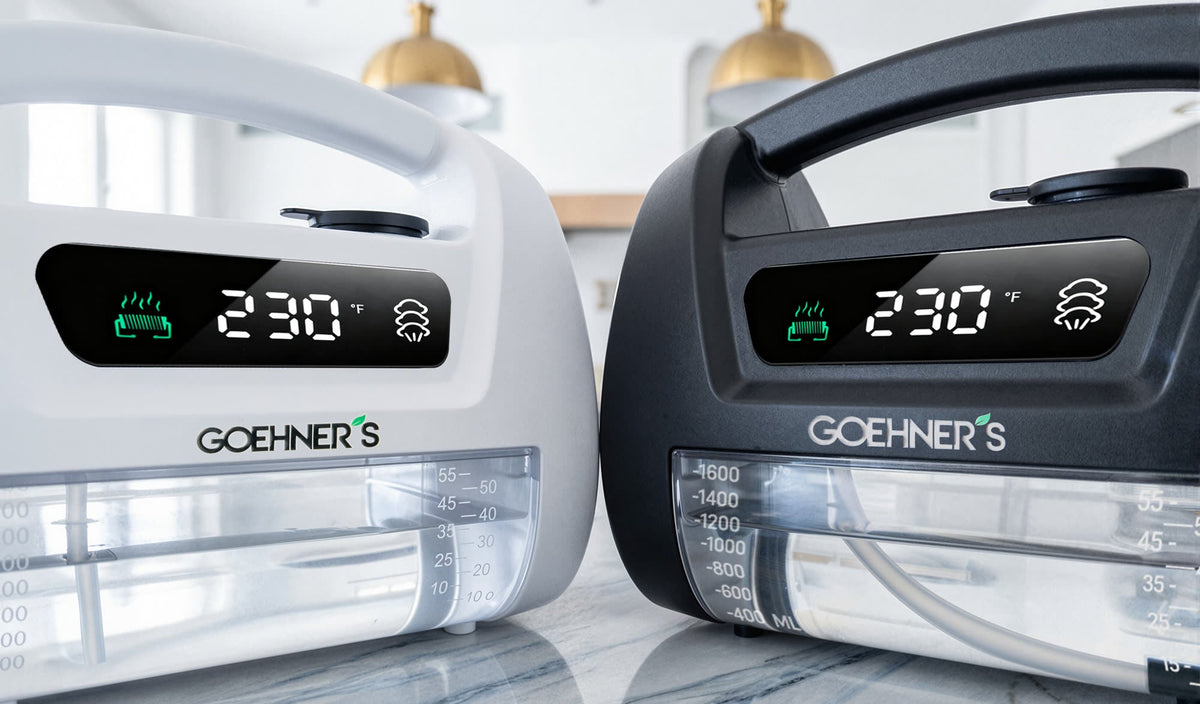
The Goehner's Handheld Steam Cleaner is not an industrial machine and doesn't pretend to be one. It's a handheld unit built for home use, running at 230°F and 50 PSI from a 1.6L (54oz) reservoir — deliberately gentler than commercial gear, which is exactly what you want on home floors, grout, and upholstery. It sits in a different category entirely from those commercial systems, and that's the point: most homes don't need commercial pressure to clean with steam. Check the current price on the product page.
See the GOEHNER'S handheld steam cleaner for the full spec sheet.
What should you expect the first time you use dry steam?
The first time you use dry steam on a surface you're used to cleaning with wet steam, you may think something's wrong. You'll squeeze the trigger, see a steam plume like any steamer, but notice the surface ends up with less water sitting on it than you're used to — and wonder whether you're actually cleaning anything.
Then you'll go over the spot with a microfiber cloth and pick up a surprising amount of loosened dirt and residual moisture — the steam did the lifting; the cloth just carries it away. The cleaning already happened. The difference isn't how much steam you can see — wet and dry steam both show a visible plume — it's that wet steam tends to spit liquid water along with the vapor and leave the surface wetter, while dry steam carries less liquid water, so it leaves less moisture behind and the surface dries faster. (Aim it at a cold window or a chrome fixture, though, and it still condenses right back into droplets — that's normal, and a useful reminder that "dry" means low-moisture, not no-moisture.)
Once you're used to it, a wet-steam unit can start to feel like a step back: more moisture, more drying time, and more caution needed on sensitive surfaces.
Later in this series, we'll cover the physics of why the two behave so differently — and what to expect the first time you restart a flash-heated unit after a short break.


