Steam Cleaner on Hardwood or Laminate Floors: Smarter Detail Uses
Steam cleaner on hardwood or laminate floors: smarter detail uses
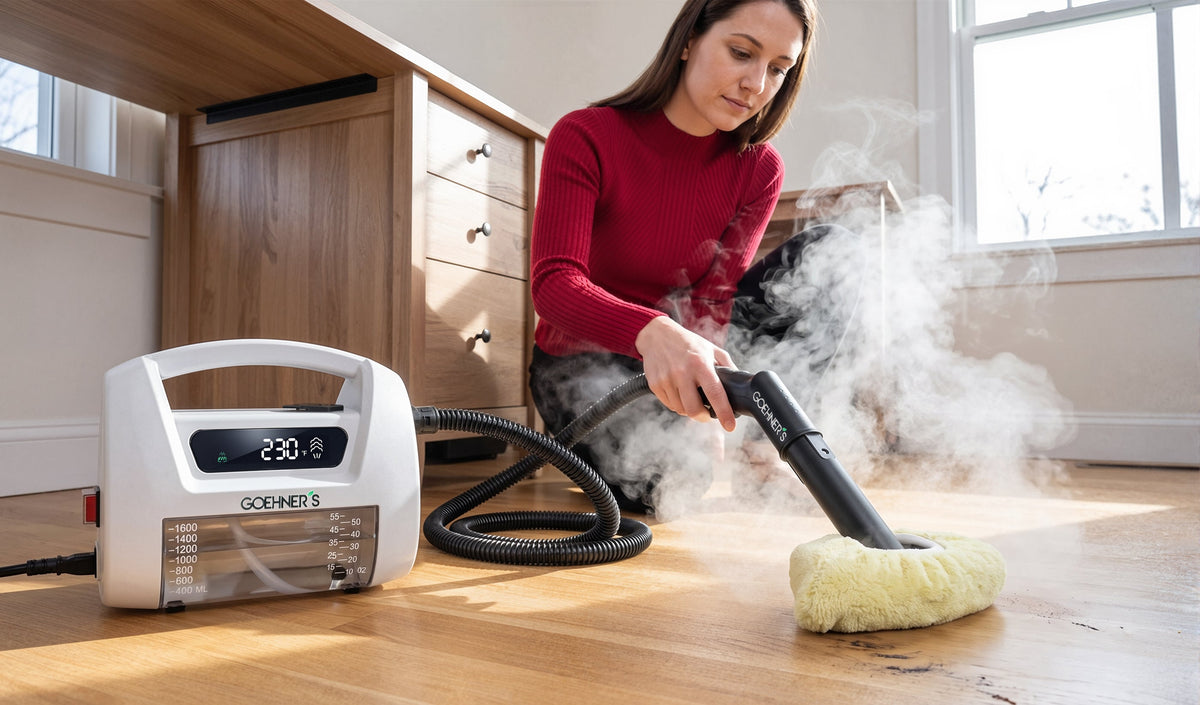
In rooms with hardwood or laminate floors, Goehner’s SteamVex steam cleaner (SteamVex) delivers its strongest value on the details around the floor: grout transitions, baseboard edges, door tracks, window rails, glass and nearby hard-surface buildup. Focused steam and purpose-matched tools reach the narrow areas broad floor cleaning leaves behind.
See SteamVex in Action
Explore the high-temperature steam, large tank, controlled output and extended reach behind this cleaning workflow.
Explore SteamVexWhere SteamVex creates value around the floor
| Detail around the floor | SteamVex tool | Cleaning action | Practical result |
|---|---|---|---|
| Grout transitions | Precision nylon brush | Move line by line and wipe immediately | Focused cleaning where flooring meets tile |
| Baseboard edges | 5 ft hose + focused attachment | Follow the narrow edge while the main unit stays in place | Less repeated hand wiping along the room perimeter |
| Door and sliding tracks | 230°F steam + detail brush | Loosen buildup inside the channel | Residue lifts from spaces a broad floor tool misses |
| Window rails and glass | Detail brush or large brush + bonnet | Move from narrow rail into broad glass | One system covers both detail and surface work |
| Nearby hard fixtures | Three steam levels | Match output to the size of the detail | Controlled cleaning around room edges |
A three-step SteamVex room-edge route
Step 1: clear the room-edge route
Vacuum or brush loose dust and grit from baseboard lines, doorway tracks, grout transitions and window rails. This gives SteamVex a clean path to the attached buildup.
Step 2: move through narrow details
Use the precision nylon brush and light-touch trigger for grout lines, rails and corners. Steam softens the residue, the brush lifts it and a clean towel carries it away.
Step 3: finish broader nearby surfaces
Switch to the large brush and washable bonnet for glass and broader hard-surface details. The bonnet buffers direct steam, absorbs moisture and loosened dirt, and expands each pass.
| SteamVex feature | Room-edge advantage |
|---|---|
| 230°F / 110°C nozzle steam | Focused heat reaches attached buildup at the point of work |
| Steady 50 PSI / 3.5 bar | Consistent output through tracks, grout and edges |
| Three steam levels | Move from broad hard surfaces into concentrated details |
| High-sensitivity capacitive touch trigger | Gentle touch-and-hold starts steam; lifting the finger stops it precisely |
| 13.2 ft cord + 5 ft hose | Up to approximately 18 ft of working reach around the room |
| 1.6 L / 54 fl oz tank | Fewer refill interruptions across several detail areas |
Build the route around each room
| Room area | SteamVex route | Result |
|---|---|---|
| Entryway | Door track → baseboard edge → nearby glass | A cleaner transition from threshold into the room |
| Kitchen | Floor transition grout → cabinet toe-kick edges → appliance seams | Focused cleaning around the places grease and crumbs collect |
| Bathroom transition | Tile grout → doorway track → glass edge | One connected route across several narrow details |
| Living room | Baseboard line → window rail → glass | Finished edges around the room’s broad surfaces |
| Sliding-door area | Rail channel → frame edge → adjacent glass | SteamVex moves from concentrated buildup into a wider finishing pass |
The room feels cleaner when the edges, tracks and transitions receive the same attention as the broad floor.
Why SteamVex fits room-edge detail cleaning
Goehner’s SteamVex is designed for the detail work surrounding hardwood and laminate rooms. The separate main unit stays in one stable position while the 5 ft hose and lightweight control handle move along baseboard edges, grout transitions, door tracks, window rails, glass and nearby hard-surface details.
Its 230°F nozzle steam, steady 50 PSI output, three steam levels and precision nylon brush place focused heat and brush action exactly where broad floor tools leave residue behind.
A 1.6 L tank, about 30-second startup, high-sensitivity capacitive touch trigger and up to approximately 18 ft of working reach keep the route moving through several room-edge tasks. See the current SteamVex configuration in the handheld steam cleaner collection.
Frequently asked questions
What should SteamVex clean around hardwood and laminate rooms?
SteamVex creates more value around these rooms by focusing on the details beside the floor: grout transitions, baseboard lines, tracks, glass and hard fixtures. The hose-based handheld structure is built to reach those narrow areas.
How does SteamVex reach around the room?
The room layout matters more to the SteamVex workflow than the floor category. A 13.2 ft cord and 5 ft hose let the main unit stay beside the work area while the control handle reaches edges, rails and nearby hard details.
Which SteamVex attachments fit room-edge details?
Use each SteamVex attachment for the detail it is designed to contact. The precision nylon brush follows tracks, grout and narrow edges; the large brush and washable bonnet expand coverage across glass and broader hard-surface details.
How does the capacitive touch trigger help?
The high-sensitivity capacitive touch trigger gives detail work precise start-stop control: a gentle touch and hold keeps steam flowing, and lifting the finger stops it. That makes short passes around room edges easier to manage without hard squeezing.
How does one SteamVex setup cover several details?
SteamVex is most valuable when the room route is planned around high-impact detail areas. Its large tank and long reach let one setup move from a doorway track to baseboard edges, window rails, glass and nearby grout with fewer resets.
Use SteamVex for the details around every floor
Use SteamVex to complete the detail work that makes a hardwood or laminate room feel finished: clean grout transitions, baseboard edges, doorway tracks, window rails, glass and nearby hard-surface buildup.
Focused 230°F steam, steady 50 PSI, three levels, light-touch control and purpose-matched tools turn those scattered details into one connected room-edge cleaning route.
Clean the Details Around Every Floor
Use SteamVex to clean the grout transitions, tracks, edges, glass and hard details that complete a hardwood or laminate room.
Choose Goehner’s SteamVex

