Back to Journal
Should You Steam Clean a Mattress? When to Skip It - Goehner's

Should You Steam Clean a Mattress? When to Skip It

Quick answer

Steam is rarely the first thing you should reach for on a mattress — not because steam is weak, but because a mattress dries slowly and traps moisture where you cannot see it. The heat is fine; the leftover dampness is the problem.

Skip steam entirely on memory foam and latex. Their slow-drying cores hold moisture the longest, so the risk-to-reward math almost never works out.

For most homes, the routine that actually keeps a mattress fresh is vacuum → spot clean → baking soda → a washable protector. It removes more of what makes a mattress smell and look dirty than a risky deep steam ever will.

If you do steam a compatible mattress fabric, treat drying as the main job, not an afterthought — a fabric surface can need roughly 4–8 hours (at least 3) to dry fully, with fans and airflow doing the work.

Is steam cleaning safe for a mattress?

Steam cleaning a mattress is only conditionally safe, and almost the whole answer comes down to one thing: whether the mattress can dry completely afterward. A tile wall dries in minutes. A mattress does not. Foam, quilting, padding, springs, adhesives, and stacked fabric layers all hold water in places you cannot see or reach.

That trapped moisture is what turns a quick refresh into a problem. Damp comfort layers can stay damp for many hours, and a bed that goes back into use before it is dry is exactly the wrong outcome. This is a materials-and-airflow question more than a machine question.

Hybrid and innerspring mattresses still have comfort layers on top that can hold dampness, so "it has springs" does not make it steam-safe. Smart or sensor-equipped mattresses add a second reason for caution: electronics do not belong anywhere near steam.

So before you ask whether a steam cleaner for a mattress is a good idea, ask two blunt questions first: does the mattress label allow it, and can your room and schedule give it a full multi-hour dry-out? If either answer is no, this is not your job for today. Fabric surfaces in general follow the same logic — for the wider reasoning on which materials tolerate steam, see what not to steam clean.

Should you steam clean a memory foam mattress?

This is the one case where we lean firmly toward "skip it." Memory foam and latex are the most heat- and moisture-sensitive mattress materials, and their dense cores are the slowest of all to dry back out. Push moisture into that kind of core and you have a problem you cannot easily pull out again.

If you have a memory foam or latex mattress, keep everything surface-level: vacuum thoroughly, spot clean lightly, deodorize with baking soda, and lean on a protector. Do not try to steam a memory foam mattress into a deep clean — the internal cleaning you are hoping for is the exact thing the material can't safely give back.

⚠️ Risk note: don't judge "dry" by the top surface. A memory foam or latex layer can feel dry on top while the core underneath is still damp, which is precisely how odor and staining problems start after cleaning.

The better routine for most mattresses: vacuum, spot clean, deodorize

For the majority of homes, this no-steam routine does more good with far less risk. It is also the routine every serious cleaning guide starts with, and each step has a job.

1. Strip and wash the bedding first. Sheets, mattress protector, and pad all go in the wash. Cleaning the mattress under dirty bedding just recontaminates it.

2. Vacuum slowly with an upholstery tool. Go slowly enough that the tool actually lifts dust, dead skin, and hair from the surface and the quilting seams — a quick pass leaves most of it behind. This is also the step that stops loose grime from turning into paste the moment any moisture is added.

3. Spot clean stains with as little liquid as possible — and match the method to the stain. For general marks, use the mildest method your mattress label allows, blot (don't soak), and press with a dry cloth after. For protein-based stains — blood, sweat, urine — reach for an enzyme cleaner and cold water, not heat: hot water and steam can set protein stains rather than lift them.

4. Deodorize with baking soda — and let it work. Sift a light, even layer over the surface and let it sit for about 1 hour (longer for stubborn odor) before vacuuming it up thoroughly. Baking soda helps mainly by neutralizing acidic odor compounds and lightly absorbing residue — it is a chemistry-and-absorption step, not something that "kills" anything, so give it time rather than vacuuming it off in two minutes.

5. Add a washable protector going forward. A protector you can throw in the wash prevents far more problems than any deep clean can fix afterward, and it makes every future cleaning a five-minute job instead of an ordeal.

How to steam clean a mattress safely (only if the label allows)

If your mattress label clears steam and it isn't memory foam or latex, here is how to keep the risk low. The goal is a light surface refresh, not a soaking.

Read the care label, then test a hidden spot. Steam a small, out-of-sight area first and check for any color change or damage before touching the sleeping surface.

Fit the bonnet first, then keep it moving. Never spray bare steam straight at the fabric — put the microfiber bonnet on the head (next step), use the lowest useful setting, and glide the bonnet-covered head lightly along the surface. Keep each pass to about 2–3 seconds and think a few quick, overlapping passes rather than parking it in one place. Lingering is what over-wets a spot and drives moisture into the core.

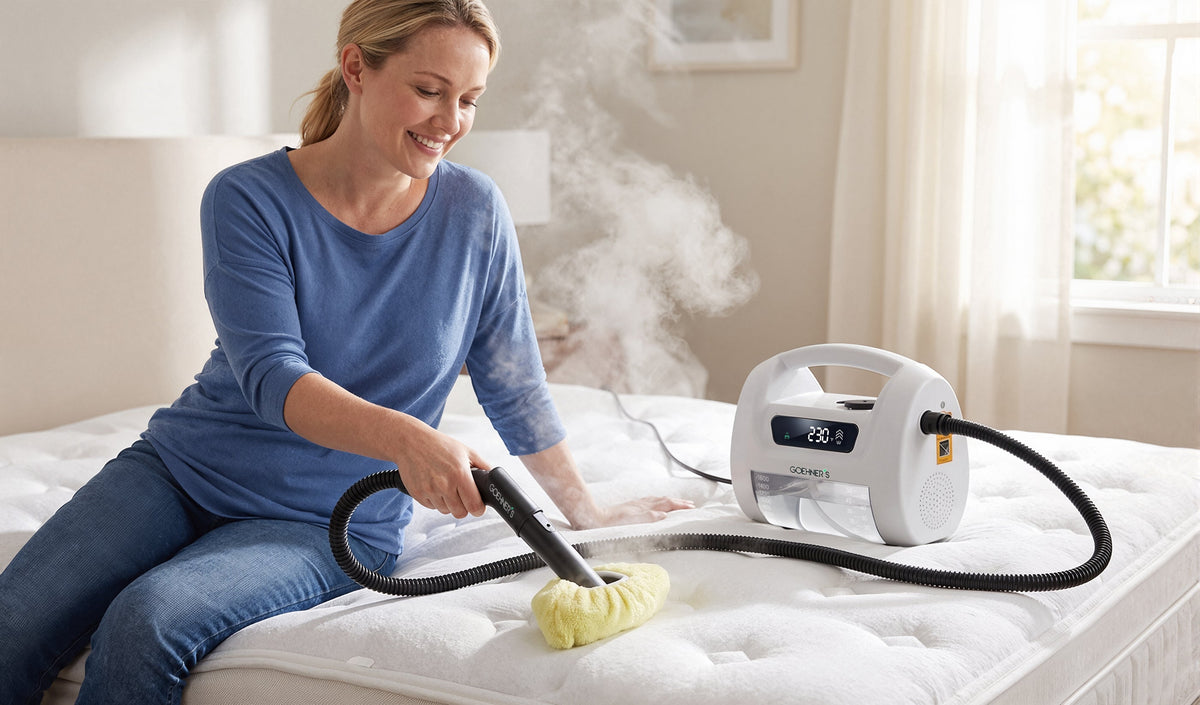
Fit a microfiber bonnet over the head and let it ride against the fabric so the steam reaches the fabric as a softer, buffered output instead of a concentrated blast. On textiles the bonnet does double duty: it buffers the heat and it carries away the loosened grime and moisture as it passes — so the pass itself is the wipe, and you don't have to guess at a "safe distance."

Let the bonnet do the wiping as you go. Steam loosens residue; it does not extract it. A handheld steamer puts moisture onto the surface but doesn't pull it back out — so it's the bonnet on the moving head, not a separate cloth, that lifts the loosened grime and some of the surface moisture with each pass. There's no need to grab another towel and wipe over what you just steamed.

Then make drying the main event. Use fans, open windows, and time — plan on roughly 4–8 hours (at least 3) before the bed is used or sheets go back on. Stand the mattress on edge if you can so both faces breathe, and add a fan or dehumidifier. Skip the steam altogether if the room is cold, humid, or poorly ventilated. If you've already done fabric seating, the same discipline carries over — the couch version of these steps walks through dwell time and drying in more detail.

What steam won't do on a mattress (and what "a few seconds" videos leave out)

It helps to be honest about the ceiling here. A handheld steam cleaner is a fabric-refresh tool, not an extractor — it can loosen and lift some surface residue and freshen fabric, but it does not deep-clean the inside of a mattress and does not remove set-in stains on its own.

This is also the place to stop trusting the short clips. Those "watch it lift in seconds" mattress and grease videos are sped-up, jump-cut demos — often with the surface pre-treated off-camera. In real use, steam cleaning is a loosen-then-wipe process: you soften residue with heat and moisture, then a person does the wiping. On a stubborn spot that means a few minutes, several overlapping passes, and patience — not one magic swipe.

The same reality check applies to the kitchen jobs a handheld like this is really built for. Baked-on range-hood grease, stovetop spatter, air-fryer interiors, and oven grime are where steam shines — but even there, tough grease means concentrating steam on a spot for 10–15 seconds, then wiping while warm, and repeating on the worst areas. It's fast and satisfying; it just isn't instant.

So the honest mattress verdict: steam is a cautious surface-refresh option on compatible fabrics, not a hygiene tool and not a deep-clean shortcut. Judge it by that, and it can earn a place; expect a miracle, and it will disappoint you.

Don't steam these (mattress edition)

A short list saves you an expensive mistake. On or near a bed, keep steam away from:

Memory foam and latex — slow-drying, heat- and moisture-sensitive cores. Any surface the label restricts, and fabrics coded "S" (solvent-clean only) or "X" (vacuum/brush only) — these never take steam or water. Smart-mattress electronics and sensors. The mattress at all if the room can't give it a full dry-out.

⚠️ Risk note: the damage from over-steaming a mattress often shows up later — an odor or a stain that appears days after cleaning — which is exactly why the dry-out rule matters more than it feels like it should.

Where a Goehner's SteamVex fits (and where it doesn't)

If you're weighing a handheld for occasional, cautious fabric work, here's the honest fit. The Goehner's SteamVex is a handheld that produces dry steam — meaning it carries less water than a wet-steam mop — rated at 230°F / 110°C, 1,800W, with a 1.6 L (54 fl oz) tank at 50 PSI (3.5 bar). On a compatible mattress fabric, with a microfiber bonnet and short dwell time, it can do a cautious surface refresh.

What it is not is a mattress extractor, and using it does not create any hygiene claim. Its real strong suit is the kitchen and bathroom detail work above — grease and grout lines — with mattresses and upholstery as a secondary, careful use.

For context, buyers cross-shopping this category often look at Dupray. A quick, honest spec compare (competitor figures from Dupray's own listing):

Spec Goehner's SteamVex Dupray Neat
Steam temperature 230°F / 110°C 275°F / 135°C
Pressure 50 PSI / 3.5 bar 50 PSI / 3.5 bar
Tank 1.6 L / 54 fl oz 54 fl oz
Power cord 13.2 ft cord + 5 ft hose ~12.9 ft cord + hose
Heat-up ~30 seconds cold, 5–10 seconds warm restart ~8 minutes
Runtime per fill ~30 minutes (Level 1) / ~15 minutes (Level 3) ~50 minutes

The takeaway isn't "ours wins every row" — Dupray runs hotter and longer per fill. It's that the SteamVex's slightly lower, gentler 230°F is genuinely easier to control on delicate fabric edges and detail work, which is the job most home users actually have. Pick on the work you'll do, not the biggest number. See the Goehner's SteamVex handheld steam cleaner for the full spec sheet and the current price on the product page.

Bottom line

Use this quick decision rule before you touch a mattress with steam: memory foam or latex → don't; label says no → don't; no room for a 4–8 hour dry-out → don't. Compatible fabric plus a full dry-out → a cautious surface refresh with a bonnet and short passes is fine.

When in doubt, skip the steam and run the routine that beats it anyway: vacuum slowly, spot clean lightly (enzyme + cold water for protein stains), let baking soda sit an hour and vacuum it up, then add a washable protector so the next clean is a five-minute job.

Frequently asked questions

Is steam cleaning safe for a mattress? Only with caution, and only if the care label allows it. It can be acceptable for a light surface refresh on compatible fabrics — but the mattress must dry completely afterward, which can take 4–8 hours. On slow-drying cores, the moisture risk usually outweighs the benefit.

Can you steam clean a memory foam mattress? We recommend against it. Memory foam and latex are heat- and moisture-sensitive, and their dense cores are the hardest of all to dry back out. Stick to vacuuming, light spot cleaning, and baking soda deodorizing.

Does steaming a mattress get rid of odor? Steam can loosen some surface residue, but for odor a light layer of baking soda left to sit about an hour and then vacuumed away is the more reliable, lower-moisture approach. Baking soda works by neutralizing acidic odor compounds and lightly absorbing residue — not by killing anything.

How do I get blood or sweat stains out of a mattress? Treat protein stains with an enzyme cleaner and cold water, and blot rather than rub. Avoid hot water and steam on these — heat can set protein stains instead of lifting them.

What's the best way to clean a mattress without steam? Strip and wash the bedding, vacuum slowly with an upholstery tool, spot clean stains with the mildest method your label allows (enzyme + cold water for protein stains), deodorize with baking soda for about an hour, then vacuum and add a washable protector going forward.

More from the Journal
How to Steam Clean Shower Glass, Grout & Bathroom Edges - Goehner's
Bathroom Steam CleanerHow to Steam Clean Shower Glass, Grout & Bathroom Edges
Steam Cleaner on Hardwood or Laminate Floors: Safe or Not? - Goehner's
Can You Steam Clean Laminate Floors?Steam Cleaner on Hardwood or Laminate Floors: Safe or Not?
Can You Steam Clean a Couch? Read the Fabric Code First - Goehner's
Handheld Steam CleanerCan You Steam Clean a Couch? Read the Fabric Code First
Ready when you are

Ready to clean smarter?

The Goehner’s Handheld Steam Cleaner delivers 230°F dry steam with PWM precision. No chemicals. No residue.

Shop now