How to Steam Clean Shower Glass Grout and Bathroom Edges
Quick answer
Clean the shower in the order that gives Goehner’s SteamVex steam cleaner (SteamVex) the most leverage: tracks and corners first, grout and tile edges next, then glass for the final wipe and dry finish. Focused steam and small brushes reach soap film and buildup where a broad cloth leaves material behind.
See SteamVex in Action
Explore the high-temperature steam, large tank, controlled output and extended reach behind this cleaning workflow.
Explore SteamVexThe hardest parts of a shower enclosure are rarely the broad tile surfaces. They are soap film on the glass, debris in the door track, buildup along grout lines, and the tight edges around faucets and frames that a cloth cannot reach easily.
Start with tracks, grout and everyday soap film
| Bathroom buildup | Where it collects | SteamVex action | Finish |
|---|---|---|---|
| Soap film and everyday residue | Glass, tile edges and fixtures | 230°F steam softens the film | Bonnet pass, squeegee and dry towel |
| Track and corner buildup | Door rails, frame joints and faucet bases | Precision nylon brush reaches the channel | Immediate towel wipe |
| Grout-line soil | Rough tile joints | Steady 50 PSI steam + moving detail brush | Collect loosened residue section by section |
| Fresh water droplets | Glass edges and hardware | Bonnet absorbs moisture and condensation | Top-to-bottom squeegee and dry finish |
Start with the narrow details, then finish on the broad glass panel so every stage builds toward a clear, dry result.
What to prepare
- Goehner’s SteamVex;
- the precision nylon detail brush for tracks, seams, grout and fixture bases;
- the large brush head with a washable cloth bonnet for glass and broader surfaces;
- several clean absorbent towels; and
- a glass squeegee for the final dry pass.
With the tools arranged before you begin, the route can move directly from narrow details to the glass finish.
How to steam clean a shower in four steps
Step 1: remove hair, dust, and loose debris
Brush or vacuum loose hair, dust and debris from the shower track, corners and grout lines. This clears the path for SteamVex heat, pressure and brush contact to work directly on attached bathroom buildup.
Place clean towels within reach and keep the squeegee ready for the final glass pass.
Step 2: clean tracks, corners, and narrow seams
Shower-door tracks, faucet bases, glass-to-metal joints, corners and narrow seams are where the SteamVex precision nylon brush adds the most value. Focus 230°F nozzle steam on a short section, guide the bristles through the channel and wipe away the released soil and condensation.
The high-sensitivity capacitive touch trigger keeps steam flowing with a gentle touch and hold, then stops when the finger lifts. That light-touch control makes frequent start-stop work easier as the brush changes direction around frames, rails and fixture bases.

Step 3: clean sound grout in short sections
Move the precision nylon brush along one short grout section at a time. SteamVex steady 50 PSI output helps carry focused steam into the rough line, the brush lifts the softened buildup and a clean towel collects it before you continue.
Repeat the same line-by-line sequence across the enclosure. For a deeper grout-specific method, continue to our guide to cleaning grout with steam.
Step 4: finish with the shower glass
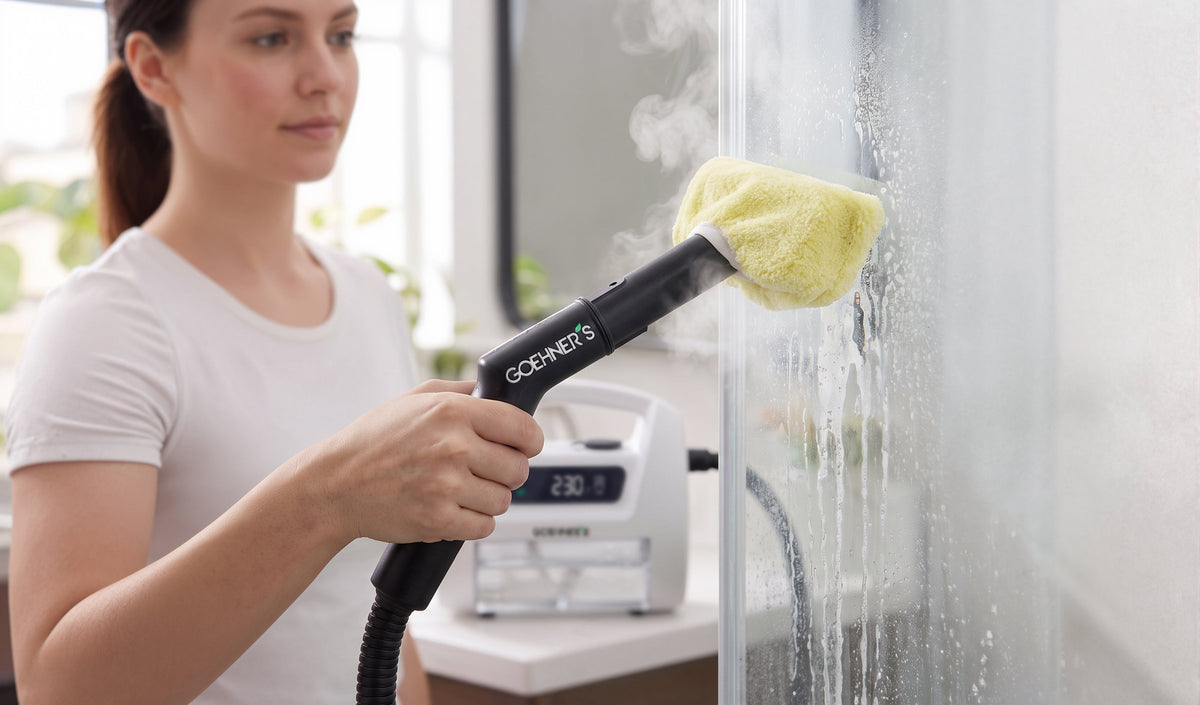
Clean the glass after tracks, corners and grout so the final panel stays clean. Fit a washable cloth bonnet over the large brush head and move in broad, overlapping passes from the top down.
The bonnet buffers direct hot-steam contact, absorbs moisture and condensation, expands the cleaning area and carries away loosened soap film. Finish with a top-to-bottom squeegee pass and a clean towel around the edges and hardware.
How to reduce new water spots
| Maintenance rhythm | Action | Benefit |
|---|---|---|
| After each shower | Squeegee glass from top to bottom and dry the hardware edges | Removes droplets before mineral traces form |
| Weekly quick reset | Use the bonnet-covered large brush on glass and the precision brush in tracks | Keeps film and rail buildup from becoming a larger job |
| Periodic detail clean | Run the full track → grout → glass SteamVex route | Restores the enclosure in one connected session |
A short after-shower finish plus a regular SteamVex detail pass keeps the clear result easier to maintain.
Which attachments are useful in a bathroom?
| Bathroom area | SteamVex tool | Practical result |
|---|---|---|
| Tracks, grout, faucet bases, frames and corners | Precision nylon detail brush | Focused access to narrow channels and rough lines |
| Tile walls and broader hard surfaces | Large brush head | More area covered with each pass |
| Shower glass | Large brush head + washable cloth bonnet | Buffers direct steam, absorbs moisture, lifts film and expands coverage |
| Glass edges and hardware | Clean towel + squeegee | Dry finish with fewer streaks and new spots |
What to look for in a bathroom steam cleaner
| SteamVex feature | Bathroom-cleaning advantage |
|---|---|
| 230°F / 110°C nozzle steam | Focused heat softens soap film at the point of work |
| Steady 50 PSI / 3.5 bar | Consistent output through tracks and grout lines |
| Three steam levels | Move from broad glass and tile into concentrated detail work |
| High-sensitivity capacitive touch trigger | Gentle touch-and-hold starts steam; lifting the finger stops it precisely |
| 13.2 ft cord + 5 ft hose | Up to approximately 18 ft of reach around the enclosure |
| 1.6 L / 54 fl oz tank | Fewer refill interruptions across glass, tile, tracks and grout |
| Precision brush + large brush and bonnet | Purpose-matched contact from narrow channels to broad glass |
How Goehner’s SteamVex fits these bathroom tasks
Goehner’s SteamVex brings the full bathroom route into one hose-based system. The precision nylon brush reaches tracks, grout, corners and fixture bases; the large brush with washable bonnet expands coverage across glass and larger surfaces.
A 13.2 ft power cord and 5 ft hose provide up to approximately 18 ft of working reach. The 1.6 L / 54 fl oz tank supports about 30 minutes on Level 1, while about 30-second startup, three steam levels, steady 50 PSI output and the light-touch capacitive trigger keep the route moving from narrow details to the final glass pass.
The value is a connected cleaning sequence with fewer outlet changes, fewer refill interruptions and less repeated hand scrubbing. See the current setup in the SteamVex handheld steam cleaner collection.
Frequently asked questions
Can a steam cleaner clean shower grout?
Yes. SteamVex combines focused 230°F nozzle steam, steady 50 PSI and a precision nylon brush to work through soap residue and surface soil along rough grout lines, one short section at a time.
Can steam remove soap scum from shower glass?
Yes. SteamVex softens soap residue, skin oils and everyday bathroom film. The bonnet-covered large brush widens the pass and collects loosened film and moisture before the squeegee creates the dry finish.
Can steam remove hard-water deposits by itself?
SteamVex first removes the soap film and everyday residue that sit across the glass. Complete the pass with the bonnet, squeegee and dry towel so the remaining surface is clean, clear and easier to maintain between showers.
What brush should I use on a shower-door track?
Use the SteamVex precision nylon brush. Its small contact area follows the track, corners and frame edges while focused steam softens the attached buildup for an immediate towel wipe.
Why does the glass still streak or show spots the next day?
A complete dry finish makes the difference. Use the bonnet-covered large brush to collect loosened film and moisture, pull the squeegee from top to bottom, then dry edges and hardware with a clean lint-free towel.
A complete SteamVex bathroom sequence
The strongest bathroom workflow follows one connected route: clear loose debris, clean tracks and corners, move along grout lines, then finish the glass with the bonnet-covered large brush, squeegee and dry towel.
SteamVex supports every stage with focused 230°F steam, steady 50 PSI output, three levels, light-touch control, long reach and a 1.6 L tank. One system moves from the smallest track to the broadest glass panel with less repeated hand scrubbing.
Reach the Bathroom Edges a Cloth Misses
SteamVex turns tracks, grout, glass and bathroom edges into one connected cleaning route with focused tools and less repeated hand scrubbing.
Choose Goehner’s SteamVex

