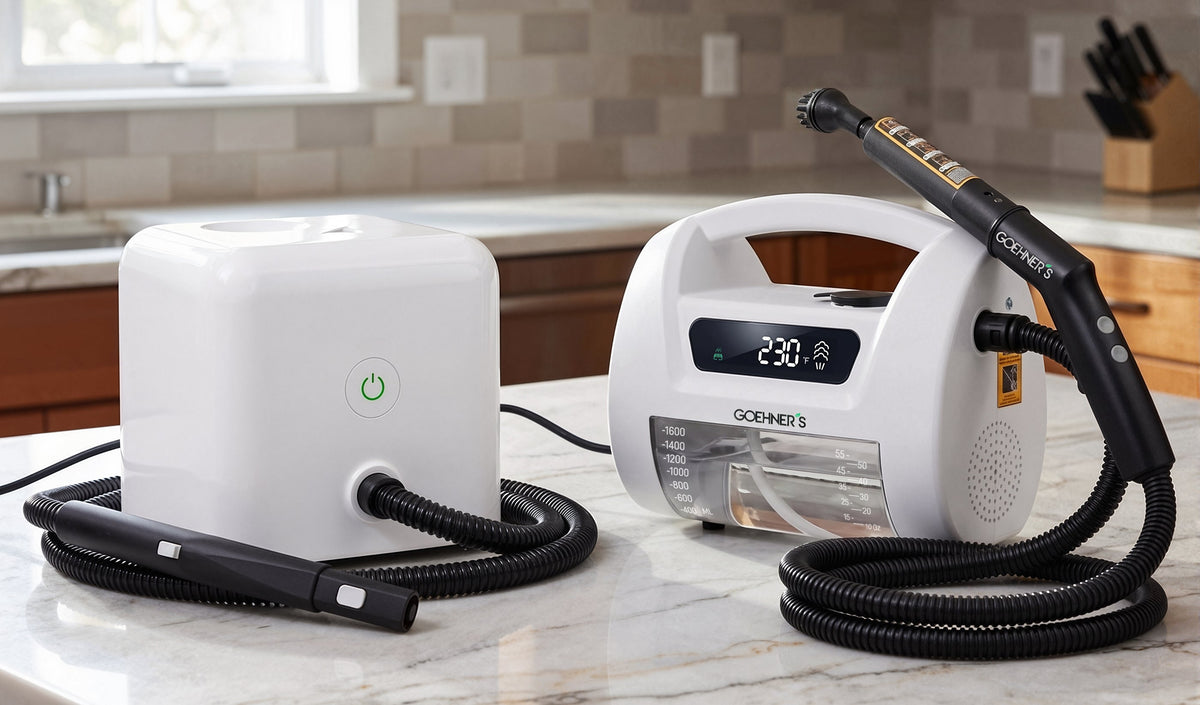
Dupray Neat vs Goehner's SteamVex: Heavy Canister Body or Compact Portable Body?
Dupray Neat vs Goehner's SteamVex: the quick answer
Short on time? Here is the split before the details.
- Same tank class, same published pressure, different body. Both sit in the 1.6 L / 54 oz tank class, and both publish 50 psi of steam pressure — so neither tank size nor pressure is the deciding factor. The real difference is canister vs compact body, warm-up rhythm, and reach.
- Buy the Dupray Neat if you want a classic canister for longer planned sessions, floor-tool accessories, and a wide accessory range, and you are fine with the footprint and roughly 8-minute heat-up (published).
- Buy Goehner's SteamVex if you mostly do frequent, close-up detail work — kitchen grease on the range hood, stovetop and air-fryer, plus grout and shower tracks — and you want a compact body that starts in about 30 seconds so it is easy to grab often.
- Before you buy any used or older Neat, check the recall date code first (details below). It affects only specific units, and the fix is a free replacement boiler cap, not a return.
Neither machine is a magic wand. Steam loosens grime; you still wipe. If a video shows grease vanishing in one second, that is an edited, sped-up demo — the honest version takes a few minutes and a warm cloth. If you are still deciding across the whole category, our best handheld steam cleaners of 2026 guide lays out how compact and canister formats compare before you narrow to a single head-to-head like this one.
How do the specs compare side by side?
Here is what each brand publishes, with the Dupray figures pulled from its official Neat page and an independent hands-on cord measurement, so you can compare like for like rather than by marketing tone.
| Spec | Dupray Neat (canister) | Goehner's SteamVex (compact) |
|---|---|---|
| Body style | Cube canister, floor-tool ready | Compact body + 5 ft hose and wand |
| Steam temperature (rated) | Up to 275 F / 135 C | 230 F / 110 C dry steam |
| Pressure (published) | 50 psi / 3.5 bar | 50 psi / 3.5 bar |
| Tank / boiler | 54 oz / 1600 ml | 1.6 L / 54 oz |
| Power | 1500 W | 1800 W |
| Heat-up (published) | ~8 minutes | ~30 seconds cold start |
| Runtime (published) | Up to 50 minutes | ~30 min (Level 1) / ~15 min (Level 3) |
| Cord length | ~12.9 ft measured (155 in) | 13.2 ft cord + 5 ft hose |
| Weight | ~9 lb | ~4.5 lb / 2.05 kg |
A note on the numbers, because it is easy to misread them. Both machines publish the same 50 psi / 3.5 bar steam pressure, so pressure is not the differentiator. The Neat runs a hotter rated steam temperature — Dupray publishes 275 F / 135 C (measurement point not specified) — and a longer runtime — that is what a canister is for. The SteamVex runs a slightly lower, gentler 230 F / 110 C dry steam at the nozzle and a much faster start, and because its water tank is separate from the heating chamber — no pressurized boiler — you can refill mid-job without waiting for it to cool down and depressurize first. Read the specs as a description of two different workflows, not a scoreboard: on stuck grease and dried food, technique and a wipe cloth decide the outcome far more than any spec line either way.
Dupray Neat: what a canister is genuinely good at
The Neat is a respected canister, and its published specs describe its job well: up to 275 F / 135 C rated steam, 50 psi / 3.5 bar, up to 50 minutes of cleaning per fill, ~8 minutes to heat, 1500 W, a 54 oz / 1600 ml boiler, a 6 ft 6 in hose, and a cord that independent testers measured at about 12.9 ft on a roughly 9 lb body.
That combination rewards a certain plan: you accept the footprint, wait for it to heat, then work through a list — floors, larger accessories, and broad whole-home sessions. Dupray also offers a wide accessory ecosystem. If you want a classic canister with floor-tool behavior and you clean in longer blocks, the Neat deserves to stay on your shortlist. The trade-off is the same one every canister makes: it is a bigger thing to set up, and the warm-up means it is less likely to be the tool you grab for a two-minute stovetop wipe.
Goehner's SteamVex: what a compact body changes
Goehner's SteamVex uses the same 1.6 L / 54 oz tank class and the same published 50 psi, but the format is a compact body plus a 5 ft hose and wand. It runs 230 F / 110 C dry steam on 1800 W, with a Level 1 runtime around 30 minutes, a Level 3 runtime around 15 minutes, and a cold start of roughly 30 seconds (a warm restart is faster).
One point worth understanding, because it is the real engineering behind any pressurized handheld: steam at normal room pressure tops out around 212 F / 100 C. Holding 50 psi raises the boiling point so the wand can maintain 230 F / 110 C dry steam at the tip. Dry steam simply carries less water than wet steam, which is why it suits edges and seams without leaving surfaces soaked. Cool glass or a spot you spray for a long time will still show some condensation — that is ordinary physics, not a fault.
The compact format is not about beating a canister at every job. It is about lowering the friction to start. A tool you can keep within arm's reach and heat in about 30 seconds is a tool you actually pick up for the small, frequent jobs — and for most kitchens and bathrooms, the small frequent jobs are the whole battle. See the Goehner's SteamVex handheld steam cleaner for the full spec sheet, and check the current price on the product page.
Which jobs is each one built for?
Match the machine to how you clean, not to a spec you will never notice.
- Whole-home floors and long sessions lean canister. If you steam floors, use large floor tools, and clean in one long block, the Neat's runtime and floor accessories are the point.
- Frequent kitchen and detail work leans compact. The SteamVex is built first for stubborn kitchen grease and tight seams: the range hood and filter, the stovetop, the air-fryer basket, oven edges, plus grout, sink rims, and shower tracks. Soft furnishings — a couch cushion, a car seat — are secondary jobs it also handles, not its headline.
- Grabbing it often leans compact. A ~30-second start means it gets used for two-minute touch-ups a canister rarely gets pulled out for.
So the honest question is not which machine is 'more powerful' — they publish the same pressure. It is which body style fits how you actually clean. If you want the deeper technique for the SteamVex's best jobs, our guide to cleaning grout with steam walks through it step by step. And if you are weighing an even smaller unit, our BISSELL Steam Shot vs Goehner's SteamVex comparison shows how a compact tool trades footprint for reach against a tiny handheld.
How to get grease and grime off — the part videos skip
This is where honest expectations save you from disappointment with either machine. The steam and brush do the loosening; a wipe just picks up what is left. Independent hands-on reviews and even manufacturers are blunt about it: steam will not instantly erase baked-on grease or dried food on its own, and stubborn spots need repeated short bursts plus a wipe, not one heroic pass.
For a stubborn kitchen job — a greasy range hood or a burnt stovetop ring — the real routine looks like this:
- Clear the surface first. Wipe or brush off loose crumbs and dust before you steam. Skip this and steam turns the loose dust and hair into a wet, muddy smear that grinds into the seams and gets harder to lift, not easier.
- Pre-soften the worst of it. For heavy grease, spread a little baking soda paste on the surface (surface only — never put anything but water in the tank) and give it 10 to 15 minutes.
- Spray and brush the spot, then wipe once the section is done. The brush-tipped nozzle does the work — hot pressurized steam plus the bristles drive the grime off. Hold it on a stubborn ring for about 10 to 15 seconds, working it with the brush; then, after you finish a small section, take a separate dry microfiber cloth and collect the residual moisture while it is still warm. Expect to go over the worst areas a few times — patience and repeated spray-and-brush passes, not scrubbing harder.
- Use the right level. Kitchen surfaces that do not mind water take the strongest Level 3 setting; wipe dry immediately after. Fabric and glass take the gentlest Level 1 so you do not oversoak.
The takeaway: a real greasy-hood job is a few minutes of steam-plus-wipe, not the one-second miracle a sped-up clip implies. That patience is normal, and it is true of any steam cleaner in this class — the Neat included.
What should you never steam?
Both machines are hot, pressurized tools, so a few surfaces are simply off-limits — this list applies no matter which one you own:
- Sealed or engineered/laminate wood floors, and waxed or oil-treated wood — heat and moisture can lift edges and cause damage that often shows up months later.
- Unsealed natural stone and porous surfaces (marble, travertine, raw stone) — steam can drive moisture in. And never put vinegar on natural stone; the acid etches it permanently.
- Silk, velour, suede, and real leather — steam can mark or distort them.
- Cold glass — a big temperature jump can crack it; on a cold day, pre-warm from a distance on the lowest setting first.
- Electronics, screens, and their seams, plus wallpaper and thin low-temperature plastics.
For upholstery in general, check the care tag first: codes S (solvent-only: often silk, wool, linen) and X (vacuum or brush only) should never see steam. When you do steam a fabric that is safe, do a hidden colorfastness test first (press a white cloth on a low spot and check for color transfer).
How do you make the clean last?
Getting a surface clean is half the job; keeping it clean is the other half. Whichever machine you buy, close the loop:
- Wipe while it is warm. Right after steaming, use a dry microfiber cloth to lift the loosened grime and any leftover moisture before it cools and re-settles. On glass, work top to bottom and buff dry with a lint-free cloth to avoid streaks.
- Let fabrics dry fully. After steaming a cushion or car seat, let it air-dry 4 to 8 hours — stand it up for airflow, add a fan, and vacuum once more when dry to restore the nap. Do not put it back in service damp, or you invite mildew.
- Prevent the repeat. For grout, let it dry 24 to 48 hours, then reseal so grease and grime have less to grab onto next time. For a range hood, a quick weekly steam-and-wipe stops the heavy buildup that forces the 15-second stubborn-spot routine.
Do this and the surface stays cleaner longer — which is the difference between feeling like the tool worked and feeling like nothing changed.
Dupray Neat recall check before you buy
On February 26, 2026, the U.S. Consumer Product Safety Commission published a recall for the Dupray Neat, and it is worth reading precisely rather than as a blanket warning. It covers only model DUP020WNA with date codes 0118-01 through 0425-05 — not every Neat, and not the Neat Plus. The date code is printed on the rating label on the bottom of the unit.
Per CPSC, the boiler can rupture if the unit is overfilled and corroded and the pressure-release valve malfunctions, which is why the remedy is a repair, not a return: Dupray offers a free replacement safety boiler cap that screws on, and consumers use their batch code at dupray.com to check eligibility. Good brands can still have model-specific safety actions; that is not a knock on the whole product line.
The practical takeaway: if you are shopping used, open-box, or older inventory, check the date code against the recall list first, and follow the current official instructions if your unit is affected.
Which one should you buy?
Choose the Dupray Neat if you want a classic canister, longer planned sessions, a wide accessory range, and floor-tool behavior, and you are comfortable with the size and roughly 8-minute warm-up (published). Just confirm the recall date code before you buy anything that is not brand-new.
Choose Goehner's SteamVex if you mostly do frequent, close-up detail work — kitchen grease and tight seams — and you want large-tank cleaning in a compact body that starts in about 30 seconds, with hose-and-wand control that is easy to grab often. See the Goehner's SteamVex handheld steam cleaner for specs and check the current price on the product page.
Whichever you pick, remember the honest bottom line: both publish the same pressure, so steam loosens and lifts the grime while you wipe up what is left — and a little patience on the stubborn spots beats any one-second clip you have seen online.
Frequently asked questions
Is there a Dupray Neat recall I should know about? Yes. On February 26, 2026, CPSC published a recall covering only Dupray Neat model DUP020WNA with date codes 0118-01 through 0425-05. The remedy is a free replacement safety boiler cap from Dupray, not a whole-unit return, and you check eligibility using the batch code on the bottom of the unit.
What is the difference between the Dupray Neat and Dupray Neat Plus? They are two different models in Dupray's lineup. The recall above applies to the specific Neat model and date codes listed by CPSC, not the Neat Plus. Check each product's own current spec page and any recall notice before buying, since model numbers and date codes determine what applies.
Is a compact steam cleaner as powerful as a canister? On paper they are closer than you would think — the Neat and the SteamVex publish the same 50 psi steam pressure, so pressure is not the divider. A canister's real advantage is a hotter rated temperature, longer continuous runtime, and floor-tool accessories for whole-home sessions; a compact body's advantage is a fast start and easy reach for frequent detail work. On edges, seams, and stuck grease, technique and wiping matter more than any spec line.
How long does the Dupray Neat take to heat up compared with a compact steamer? Dupray publishes an 8-minute heating time for the Neat. Goehner's SteamVex publishes a cold start of about 30 seconds, which is why a compact machine tends to get used more often for quick touch-ups, while a canister's longer warm-up suits planned sessions.
Will either one remove baked-on kitchen grease in seconds like in videos? No — and that is worth knowing before you buy. Those clips are sped up and edited. In real use, repeated bursts of steam loosen and lift the grease off the surface; you then wipe up the residual moisture with a warm cloth, and stubborn spots take a few 10-to-15-second bursts plus a wipe. Steam does the heavy lifting, but it is not a wipe-free miracle on its own.
