Handheld Steam Cleaner Comparison: Goehner's vs BISSELL, Vapamore, McCulloch & Dupray (2026)
First, a disclosure: one of the products in this comparison is ours, Goehner's SteamVex. This is not a victory lap. The useful way to compare steam cleaners is to put published specifications next to each other, say plainly where a competitor is stronger, and mark unknowns as unknown instead of guessing.
Short version: who each one fits
1. Lowest upfront budget / occasional spot cleaning: BISSELL Steam Shot class, but check the current model page and recall status before buying.
2. Longest warranty on paper: Vapamore MR-75 Amico, with a lifetime warranty listed on its official page.
3. Budget handheld with a longer cord: McCulloch MC1230.
4. Whole-room cleaning and canister-style runtime: Dupray Neat, but it is the heaviest and least portable — a bulky box-shaped canister body that sits on the floor while you work the wand around it.
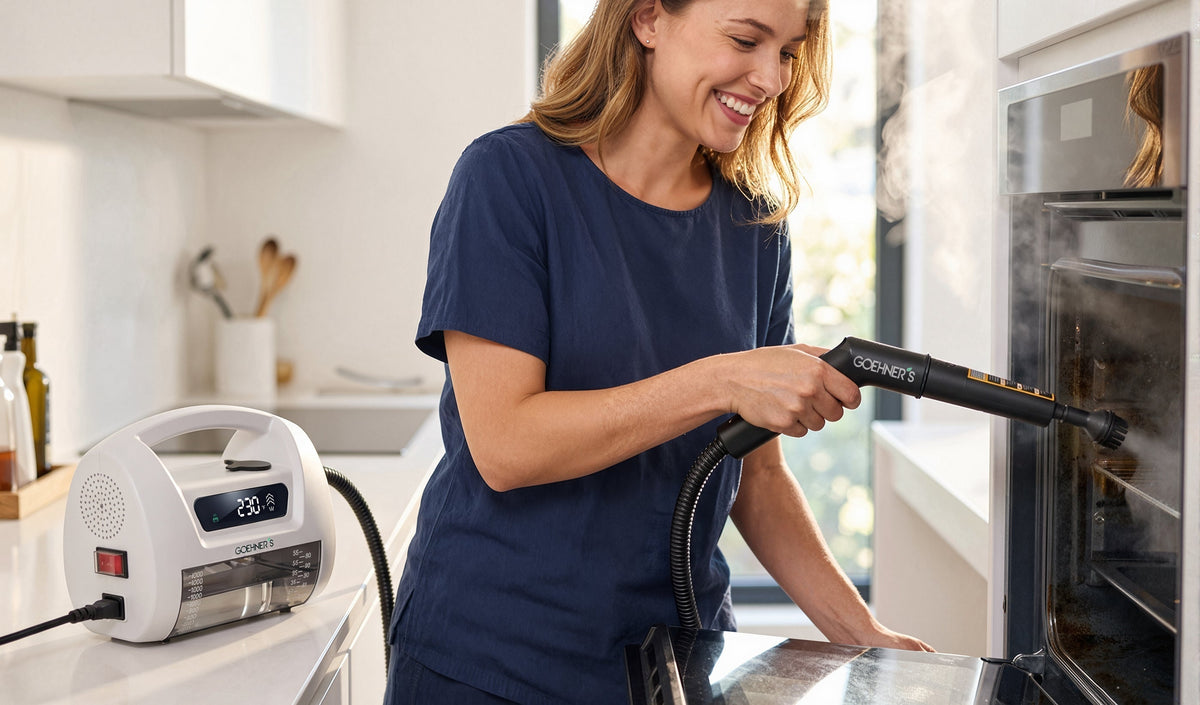
5. Largest tank in this handheld-class comparison, fast start, and no pressure-boiler cool-down refill wait: Goehner's SteamVex — aimed most at kitchen grease and grout/crevice detail work.
Quick product cards
Each card below adds a short, honest read: what the machine is good for, and where it falls short. These notes are based on each brand's published specs and the general behavior of that machine class — not on a lab test we ran ourselves. Use the full table further down to compare the numbers directly.
Goehner's SteamVex
• Best fit: kitchen grease (range hood, cooktop, air-fryer basket, oven) and grout/crevice detail; longer cleaning sessions on hard, water-safe surfaces. Upholstery and car seats are secondary jobs, done with a microfiber bonnet.
• Key specs: 54 oz / 1.6 L tank, rated 230°F / 110°C dry steam at the nozzle, 50 PSI / 3.5 bar, 1800W.
• Good at: staying on the job. The water tank sits separate from the heating chamber — no pressurized boiler — so there is no cool-down-and-depressurize wait to refill: power off, open the pressure-release cap, top up, and it is steaming again in about 30 seconds. That plus the large 54 oz tank means less stopping on greasy kitchen surfaces and grout lines, and the body-plus-hose layout keeps most of the weight off your hand. A 13.2 ft cord plus a 5 ft hose gives about 18 ft of working reach, so one outlet usually covers the whole job.
• Falls short: it is not the cheapest option, and like every steam cleaner the steam and brush head do the loosening while a wipe picks up the leftover moisture and residue — this is minutes of spraying and brushing, not a few-second miracle. It is not a fast whole-floor mop.
BISSELL Steam Shot / OmniReach
• Best fit: occasional low-budget spot cleaning.
• Key specs: check current official/retail materials for detailed numbers.
• Good at: it is the widely known small-handheld class, with a low entry price for one-off jobs.
• Falls short: the small tank limits it to short passes, and certain Steam Shot (2024) and Steam Shot OmniReach (2026) models carry CPSC recalls — check the exact model and its remedy status first.
Vapamore MR-75 Amico
• Best fit: small detail jobs where warranty length is the deciding factor.
• Key specs: 6.7 fl oz tank, 210°F, pressure not published by the manufacturer, 1000W, 3 lb.
• Good at: warranty, on paper — the official page lists a lifetime warranty, which is rare in this class.
• Falls short: a 6.7 oz tank is a short-session tool; expect frequent refills on anything bigger than a small spot.
McCulloch MC1230
• Best fit: budget handheld jobs where cord reach matters.
• Key specs: 6 oz tank, 200°F water, 900W, about 3 lb, 15 ft cord.
• Good at: reach and price — a longer cord than many small handhelds, at a low official-page price.
• Falls short: the 6 oz tank runs down quickly, and the official page does not state operating pressure, so its ability to drive steam into tight grout lines is hard to judge from the spec sheet.
Dupray Neat
• Best fit: longer canister-style sessions across whole rooms.
• Key specs: 54 oz / 1.6 L tank, Dupray publishes 275°F (measurement point not specified), 50 PSI / 3.5 bar, 1500W, 9 lb.
• Good at: capacity and runtime — a big tank and a long listed session make it a genuine multi-room reference point, and its higher published temperature can suit some heavy jobs.
• Falls short: like the SteamVex it is a body-plus-hose-plus-wand machine — you steer the wand while the body stays put — but at 9 lb its bulky canister body sits on the floor and is awkward to move around a room, the heat-up is long, and certain units carry a 2026 CPSC recall on specific date codes — check yours before buying.
Comparison table
| Spec | Goehner's SteamVex | BISSELL Steam Shot / OmniReach | Vapamore MR-75 Amico | McCulloch MC1230 | Dupray Neat |
|---|---|---|---|---|---|
| Type | Compact handheld-class body + hose/wand | Small handheld class | Small handheld | Small handheld | Canister |
| Price | Check current price | Check current official/retail page | Check current official/dealer price | Budget tier — check official page | Premium tier — check official page |
| Tank | 54 oz / 1.6 L | Check current model materials | 6.7 fl oz | 6 oz | 54 oz / 1.6 L |
| Runtime | Low steam ~30 min / high steam ~15 min | Check current model materials | Small-tank detail-cleaning use | ~10 min listed | Up to ~50 min listed |
| Heat-up | ~30 sec | Check current model materials | 4 min | ~3 min | 8 min |
| Temperature | Rated 230°F / 110°C (at the nozzle) | Check current model materials | 210°F | 200°F water | Dupray publishes 275°F (measurement point not specified) |
| Pressure | 50 PSI / 3.5 bar | Check current model materials | pressure not published by the manufacturer | Not stated on official page | 50 PSI / 3.5 bar |
| Power | 1800W | Check current model materials | 1000W | 900W | 1500W |
| Weight | 4.5 lb body | Check current model materials | 3 lb | ~3 lb | 9 lb |
| Cord + hose | 13.2 ft cord + 5 ft hose | Check current model materials | check current official materials | 15 ft cord | 16 ft cord + hose |
| Warranty | 3 years; 5 years for launch-window purchases | Check current model materials | Lifetime warranty listed | 2 years | 2 years |
Note: competitor specs can change by model and year. Always check the current official product page or manual before purchase. For BISSELL, several figures vary by model, so those columns point you to the current source rather than show a number that might not match the model you are looking at. One cord note worth flagging: Dupray publishes a 16 ft cord, but at least one independent hands-on measurement put the usable cord closer to 12.9 ft — so treat cord figures as brand-stated unless you can measure them yourself.
First, how to read this table
Specs only matter when they predict cleaning behavior. The numbers that actually predict behavior are tank size, runtime, heat-up, pressure, output temperature, power, reach, handling, and safety history. A low price does not help if the tank is too small for your job. A high temperature number does not help if it is boiler temperature rather than output temperature. A light body does not tell the whole story if the whole unit has to stay in your hand. For a plain-English walkthrough of each spec, see How to Choose a Handheld Steam Cleaner: 7 Specs That Matter.
One more expectation to set before the numbers: the "seconds to grease-free" clips you see on TikTok are sped-up or jump-cut demos, often with the surface pre-treated off camera. In real use, the brush-head nozzle drives hot steam into the grime and brushes it loose — a greasy cooktop spot usually takes a few minutes and several passes of spraying and brushing, then a dry-cloth wipe to pick up leftover moisture, with baked-on carbon needing more spray-and-brush passes and patience still. The spraying and brushing does the cleaning; the wipe just collects the residue. Any machine in this table works that way.
Tank and runtime
The biggest practical difference here is runtime, not temperature.
Vapamore MR-75 and McCulloch MC1230 are small-tank handheld machines. They make sense for a short detail pass: a sink edge, a short grout section, one appliance corner, or a small sticky spot. They are not designed to clean a whole bathroom or work through a greasy kitchen without pauses.
Goehner's SteamVex and Dupray Neat both use a 54 oz / 1.6 L tank. That puts them in a different use case. Goehner's lists about 30 minutes on lower steam and about 15 minutes on higher steam. Dupray lists up to about 50 minutes. Treat all runtime numbers as lower-output or best-case figures, because steam level, trigger use, brush choice and surface all change water consumption — a heavier steam level burns through the tank faster.
The buying question is simple: are you buying for one spot, or for a real cleaning session across a greasy kitchen or a full run of grout lines?
Heat-up and refill
Heat-up decides whether the tool feels convenient enough to use often.
Goehner's cold start is about 30 seconds. Vapamore lists 4 minutes. McCulloch lists about 3 minutes. Dupray lists about 8 minutes. Canister machines can justify a longer heat-up if they then give a long session, but for small home tasks, start friction matters.
The commonly skipped number is refill. Pressure-boiler designs heat water inside a pressurized chamber, so the cap often cannot be opened until the unit cools. Goehner's uses flash heating rather than a traditional pressure-boiler refill rhythm. The correct refill workflow is still controlled: power off, release the cap, add distilled or purified water, close the cap, then power on again. The point is not "no safety routine" — it is that you are not waiting for a pressure boiler to cool down before you can top up mid-job.
Temperature and pressure
Dupray Neat publishes 275°F (measurement point not specified) and 50 PSI / 3.5 bar. Goehner's is rated at 230°F / 110°C at the nozzle and 50 PSI / 3.5 bar. Vapamore publishes 210°F, with pressure not published by the manufacturer. McCulloch states 200°F water but does not state pressure on the official page.
Two honest points here. First, boiler temperature is not the same as surface temperature — steam loses heat through the hose, nozzle, air gap and attachment, so a hotter boiler number does not translate one-to-one to what hits the grease. A cleaner comparison separates boiler temperature, nozzle/output temperature and pressure. Second, Goehner's and Dupray both sit at 50 PSI, so pressure is not a Goehner's advantage over Dupray; the real differences between those two are size, temperature and runtime, not pressure. Where pressure does matter is against the small handhelds and machines that do not publish a pressure figure at all: driving steam into grout lines, corners and window tracks is where a stated 50 PSI earns its keep.
Power
Power is not the whole story, but it helps explain heating and recovery. Goehner's is 1800W. Vapamore MR-75 is 1000W. McCulloch MC1230 is 900W. Dupray Neat lists 1500W. Higher power does not automatically mean better cleaning, but it can support faster heating and steadier steam recovery when the rest of the design is built for it.
Weight and handling
Body weight is not always the weight in your hand.
With a compact body plus hose/wand design, the body can sit on the counter, floor or a nearby surface while your hand moves the lighter hose end. That is different from a one-piece handheld where the whole machine and its water weight stay in your hand. For longer cleaning — a full kitchen or a run of grout — cord length, hose length and where the body sits matter more than body weight alone.
Safety and recalls
Steam cleaners combine heat, water, caps, hoses, attachments and pressure. Safety history deserves more attention than price.
As of July 3, 2026, CPSC has recall notices for BISSELL Steam Shot products in 2024 and BISSELL Steam Shot OmniReach products in 2026. CPSC also has a 2026 recall notice for certain Dupray Neat steam cleaners. That does not mean every unit from those brands is affected, but buyers should check model numbers, serial/date ranges and official recall instructions before buying.
As of this article, no matching CPSC recall is on record for Vapamore MR-75, McCulloch MC1230 or Goehner's. That is not a permanent guarantee, so recheck CPSC.gov before buying.
Goehner's separates the water tank from the heating chamber, and the tank is not a pressure boiler. That is why the Dupray recall failure mode does not map directly to Goehner's design. It still uses hot steam, so normal steam-cleaner safety applies. Before your first session, it also helps to know what not to steam clean.
What not to steam clean (and why)
No steam cleaner in this comparison changes this list. Heat plus moisture damages some materials no matter which machine sprays it, so keep steam off:
• Solid hardwood and laminate / engineered "wood" floors — moisture works into seams and can cause warping, cupping or delamination; the damage often shows up months later.
• Unsealed or porous stone (marble, travertine, slate) and unsealed, waxed or oil-soaped wood — steam drives moisture in and can dull or etch the surface.
• Velvet, velour and synthetic suede (Dralon-type) pile — direct steam crushes and marks the nap.
• Leather and suede — heat and moisture stiffen, darken and mark it.
• Cold glass — hitting cold glass with hot steam risks a thermal-shock crack; if you must, warm it first from a distance on a low setting.
• Electronics and screens — moisture gets behind the glass and into seams.
• Upholstery with a care code of S (solvent-clean only) or X (vacuum/brush only) — these fabrics are not steam-safe; check the tag before you start.
For fabrics coded W or WS that are steam-friendly, still fit a microfiber bonnet and test a hidden spot first. When in doubt, do a colorfastness check: press a damp white cloth on a hidden area and look for color transfer before steaming anywhere visible.
How to actually get a good result
The spraying and brushing does the cleaning; you finish the job. A short routine beats a powerful machine used wrong:
1. Clear the surface first. Vacuum or wipe loose dust and crumbs, or steam turns dry debris into a wet smear that gets pushed into seams and is harder to clean off.
2. Match the steam level to the surface. Use the highest setting for hard, water-safe kitchen grease — a cooktop, range hood or air-fryer basket that you will wipe dry right after. Drop to the lowest setting for upholstery, delicate trim and glass, where a wetter blast just soaks the surface.
3. Work in small areas and give grime time. Hold the nozzle close on grout and grease, let heavier spots soften over a few passes rather than one long blast, and reapply instead of parking the steam in one place (a soaked spot can wick, streak or grow mildew).
4. Wipe once the section is done. After spraying and brushing a small area, take a separate dry microfiber cloth to collect the leftover moisture and loosened residue while it is still warm, before it dries back on.
5. Prevent the repeat. Let grout dry, then reseal; buff glass dry from the top down; and vacuum fabric again once it is fully dry.
Price and warranty
Prices move, so do not treat any floating price as permanent — check each one on its own current official page. On tier, McCulloch MC1230 sits at the budget end and Dupray Neat at the premium end, with Goehner's between them. Vapamore MR-75 depends on the current official/dealer route, and BISSELL pricing should be checked on its current official page or retail listing and paired with the recall check above.
Warranty matters because steam cleaners use heat, water, pressure and attachments. Goehner's offers 3 years, with 5 years for launch-window purchases. Vapamore MR-75 lists a lifetime warranty. McCulloch MC1230 and Dupray Neat list 2 years. BISSELL warranty depends on the exact model.
Bottom line
There is no universal best steam cleaner.
If you only clean occasional small spots, a lower-cost small handheld may be enough. If you want long canister-style sessions across whole rooms and can accept a 9 lb machine, Dupray Neat is a strong reference point. If warranty length is your deciding factor, Vapamore MR-75 stands out. If your real jobs are kitchen grease and grout detail and you want a compact handheld-class machine with a 1.6 L tank, 50 PSI pressure, fast start and a refill routine that does not require pressure-boiler cool-down, Goehner's SteamVex is the one in this group built around that combination.
See the Goehner's SteamVex handheld steam cleaner for the full spec sheet. Check the current price on the product page.
Frequently asked questions
What is a pressurized handheld steam cleaner and do I need one? It is a handheld-class steamer that pushes steam out under pressure — Goehner's SteamVex is rated at 50 PSI / 3.5 bar with an 1,800 W heater — which helps drive steam into grout lines, corners, and tracks. You want one if your jobs are detailed and repeated; for a single occasional spot, a small unpressurized handheld can be enough.
Is the BISSELL Steam Shot a good handheld steam cleaner? It is a low-cost, one-piece handheld that works for short spot jobs, but its small tank limits longer sessions, and certain Steam Shot (2024) and Steam Shot OmniReach (2026) models carry CPSC recalls — check the exact model and its current remedy status before buying.
Can a handheld steam cleaner clean a whole room, or just spots? It depends on tank size and heat-up. Tiny 6-7 oz handhelds are built for spots and need frequent refills; a 1.6 L / 54 oz tank like the SteamVex is sized to move across a full room before you top it up.
Can you use a handheld steam cleaner on car seats and interiors? Yes, on compatible surfaces — before you work a fabric seat, fit the included microfiber bonnet over the brush head so the fabric never takes a direct blast (the bonnet is the heat buffer), keep steam away from screens and electronics, and always test a hidden spot first.
Is the BISSELL Steam Shot or Dupray Neat under recall? CPSC lists recalls for certain BISSELL Steam Shot models (2024) and Steam Shot OmniReach models (2026), and for certain Dupray Neat units (2026, specific date codes). None of these means every unit is affected — verify your exact model and its current remedy status on the CPSC site before buying.


