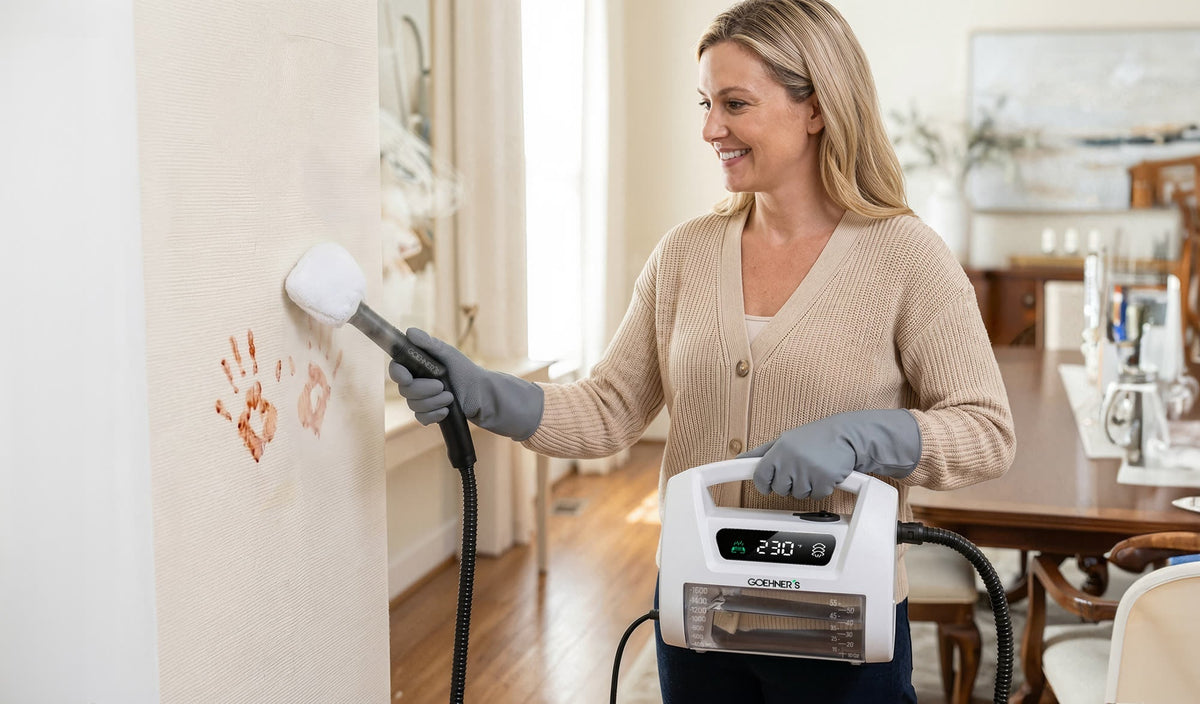
How to Choose a Handheld Steam Cleaner: 7 Specs
If you've spent ten minutes shopping for a handheld steam cleaner, you've already seen the trick: every product page leads with the same vague language. "Powerful steam." "Long-lasting." "Multi-surface." Almost none of them tell you the numbers that decide whether the unit will actually clean your grout — or just trickle out lukewarm water instead of real steam.
This guide cuts through that. Here are the seven specs that actually predict cleaning performance, what good values look like, and which numbers brands deliberately don't print on the box.
1. Steam temperature (target: 230°F / 110°C)
The whole point of steam cleaning is heat. Below 200°F you're essentially using a humidifier. At 230°F the steam is hot enough to soften grease and loosen soap scum without any chemicals — the heat lowers the viscosity of the oily, greasy film so the deposit loosens and lifts away far more easily than it would in cold water — warming a fat or oil lowers its viscosity and softens the film, which is basic physical chemistry (Chemistry LibreTexts).
What to look for: A clearly stated maximum temperature, ideally measured at the nozzle (not at the boiler — those numbers are higher because the steam loses heat through the hose). 230°F at the nozzle is a strong, realistic target for a sealed-tank handheld unit.
Red flag: "Up to 250°F" with no further detail. That's usually the internal boiler temperature, not what reaches your tile.
2. Steam pressure (target: 50 PSI / 3.5 bar)
Temperature softens the grime; pressure helps lift it free. Without enough pressure, the steam diffuses on contact and does almost nothing on stuck-on dirt.
What to look for: 50 PSI (or 3.5 bar — same thing, different unit). This is the threshold where steam can actually penetrate grout lines and work loose baked-on cooking residue.
Red flag: Pressure not listed at all. Many cheap units don't disclose it. If you can't find a number, assume it's low.
3. Heat-up time (target: under 1 minute)
This is the one spec that affects how often you'll actually use the thing. A steam cleaner that needs five minutes to heat up gets used twice and then lives in a closet. A 30-second heat-up gets used every weekend.
What to look for: 30 seconds is excellent. Under a minute is acceptable. Anything over two minutes tends to mean a lower-powered heating element.
Red flag: "Fast heat-up" with no number. If they had a competitive number, they'd print it.
4. Tank size and continuous steam time
These two numbers are linked, and both matter — but only when you know they're linked.
A small tank with high steam output empties in five minutes. A large tank with low output lasts forever but cleans nothing. The honest spec is continuous steam time on the highest setting.
What to look for: a 1.5 L+ (51 oz+) tank, with clearly stated continuous run time per setting. Be careful here: a single "30 minutes" figure usually hides the trade-off. Steam output is not constant — turn it up and the tank empties faster. On the highest output setting, expect roughly 10–15 minutes of continuous steam; on the lowest setting, that same tank can run closer to 30 minutes. A claim of "30 minutes" with no setting attached is the spec to question.
Bonus spec: How fast can you get back to steaming after a refill? A traditional boiler heats a whole tankful, so you have to switch it off and wait 8–15 minutes for it to cool before you can open it and top up. A flash-style heater only heats a small chamber, so the routine is simpler and safer: press power off, refill the reservoir, power back on, and you're steaming again in about 30 seconds — no long cool-down wait. That short turnaround matters more than the raw runtime number, because it removes the cool-down entirely.
5. Cord length (target: 13+ feet)
Outlet positioning is the silent productivity killer of any handheld appliance. A 6-foot cord means you'll unplug, reposition, plug in, and reheat for every section of every room.
What to look for: a 13.2 ft power cord. Combined with a 5-foot steam hose, that gives you 18 feet of working radius — enough to clean a full bathroom or the entire interior of a car without unplugging.
It's also worth checking the cord itself is UL-listed. On an 1,800-watt appliance the power cord carries real current, and budget units sometimes ship uncertified cords — a genuine overheating risk you can't see in a length number.
Red flag: Cord length not listed in the main specs. They know it's short.
6. Safety features (the ones that matter)
Steam cleaners get hot. Water and electricity meet inside them. Cheap units cut safety corners that you only discover when something goes wrong. Look for all four of these, not just one or two:
- Child lock — prevents accidental trigger pulls. Essential if you have kids.
- Low-water alarm — signals you when the tank is running low, so you can refill in time and avoid running the unit dry. (Note: this is an alarm that prompts you to act, not an automatic power cut — so don't ignore it.)
- Drop-detection auto-stop — cuts steam immediately if the unit falls. Prevents burns and fire risk.
- Sealed body construction — the housing should tolerate the splashes that come with steam-cleaner use. Look for a sealed seam between the upper and lower shells, not just a cosmetic cover.
Red flag: Vague phrases like "safety certified" or "engineered for safety." Demand the specific feature names.
7. Independent third-party certifications
Anyone can claim a product is safe. Independent labs are the proof. Look for at least two of these on the product page:
- CE-LVD — required for EU sale, certifies electrical safety against the EN 60335 international standard. A widely recognized electrical safety mark in the EU and many other markets.
- UKCA — UK equivalent of CE, post-Brexit. Same EN 60335 testing requirements.
- ETL or UL — North American voluntary marks. They test against largely overlapping IEC 60335 family standards. CE-LVD covers EU/UK markets; ETL/UL covers North America.
- RoHS — restricts hazardous substances in electronics. EU + UK markets require it; a sign the manufacturer takes materials seriously.
- GS — German safety mark, voluntary but rigorous.
Red flag: No certifications shown on the product page. Either the product hasn't passed any, or the seller doesn't think you'll check. Either way, walk away.
A worked example: how the GOEHNER'S handheld measures up
Just so you can see how the framework applies to a real product, here's how the GOEHNER'S handheld steam cleaner compares against each of the seven specs:
| Spec | Target | Goehner's Handheld Steam Cleaner |
|---|---|---|
| Temperature | 230°F | 230°F at the nozzle |
| Pressure | 50 PSI | 50 PSI / 3.5 bar |
| Heat-up | Under 1 min | 30 seconds (5–10 sec on a warm restart) |
| Tank / runtime | 1.5 L+ / 25 min | 1.6 L / 54 fl oz; ~15 min continuous on highest setting,~30 min on lowest; power off, refill, power on, steaming; again in ~30s — no long cool-down wait |
| Cord | 13+ ft | 13.2 ft UL-listed cord + 5 ft hose = 18 ft total reach |
| Safety | All 4 | Child lock · low-water alarm · drop-detect · sealed body |
| Certifications | 2+ | CE-LVD · UKCA · RoHS (EU+UK) · GS-PAHs |
Every number is independently verifiable: the product carries independent safety certifications, every spec is published on the product specifications page, and you can check the current price on the product page.
If you take only one thing from this guide, take this: the brands that publish complete numbers are the brands worth buying from. Vague language is a tell.
For the steam-quality side of the decision — the difference that actually determines how a unit performs on hardwood and grout — read What Is Dry Steam? A First-Time Buyer's Guide.
